







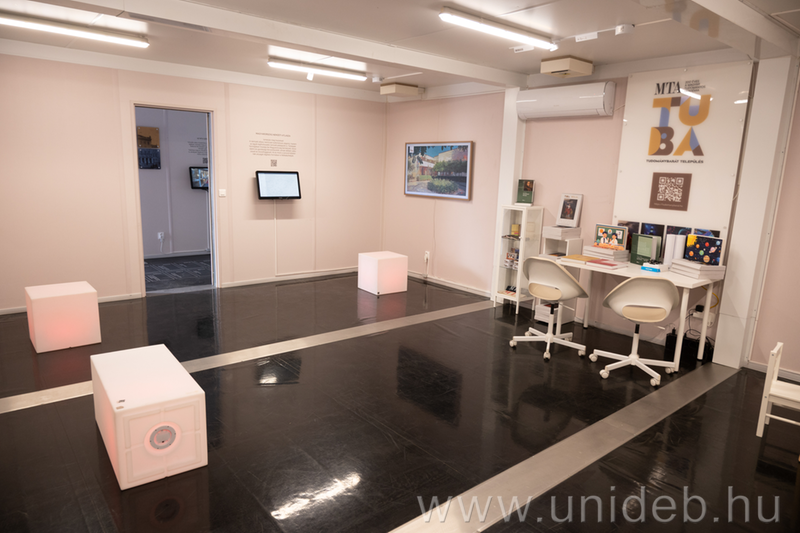
A travelling exhibition has opened in front of the Main Building of the University of Debrecen to mark the 200th anniversary of the founding of the Hungarian Academy of Sciences (MTA). The interactive exhibition aims to bring science closer to visitors in an engaging way, present the history of the Academy, and showcase the work of researchers.
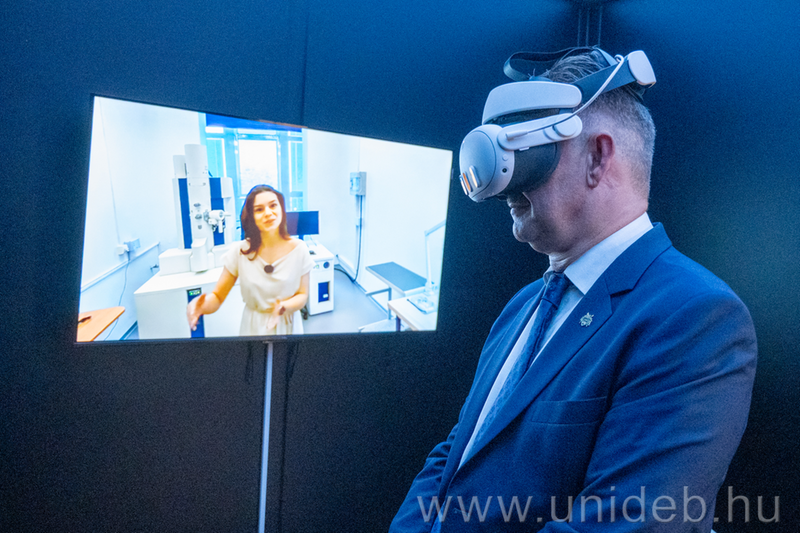
The Hungarian Academy of Sciences’ exhibition titled Science in Motion, which arrived in Debrecen from Balatonfüred, is housed in five interconnected containers covering more than 70 square metres. Among other attractions, visitors can watch a short film about the history of the MTA created using artificial intelligence. With the help of VR headsets, they can explore the headquarters of the MTA, an observatory and a microscopy laboratory. The exhibition also features the video series Science to Me, in which 22 outstanding and internationally recognised Hungarian researchers, including Katalin Karikó, speak for one minute each about the importance of science. Hungary’s National Atlas can also be explored digitally, presenting the country’s natural, social and economic spatial structure through maps. Films introducing the University of Debrecen are also being screened.
At the opening ceremony, Zoltán Bács, Rector of the University of Debrecen, said that the relationship between the university and the MTA has a long history, with a new chapter beginning earlier this summer.
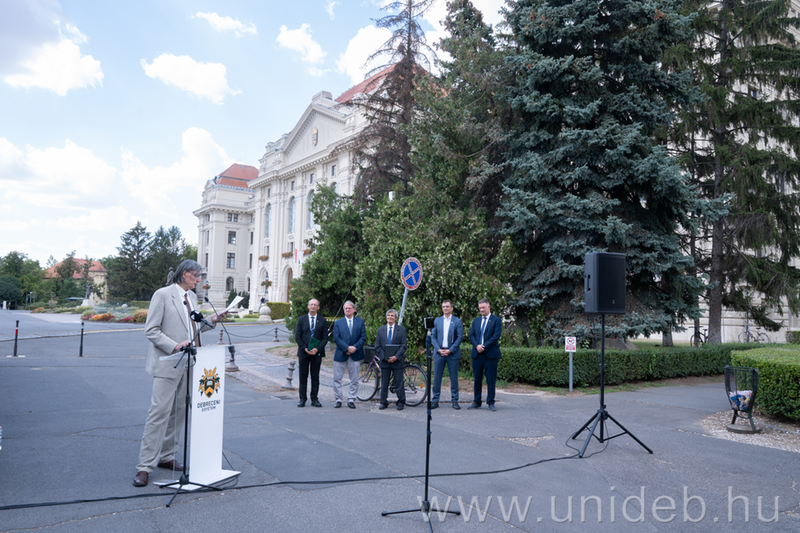
“We are adapting the system through which we carry out our tasks to the size, diversity of responsibilities and level of responsibility of the university, with many people working within it. As part of the renewed management structure, we established the positions of President for Education and President for Science at the beginning of the summer. The latter coordinates tasks related to the institution’s research and scientific activities,” said Professor Zoltán Bács, Rector of the University of Debrecen, before handing over the floor to the university’s President for Science.
Professor Ferenc Kun said that, as a physicist, academician and the university’s President for Science, he considers one of the most important messages of the 200th anniversary to be that the continuity of science is created by communities and institutions.
He explained that the MTA is not merely an impressive headquarters in Budapest, nor simply a list of outstanding scientists. The Academy is a living professional community that is present at universities and research institutions, in scientific bodies and in shaping the careers of young researchers. At the University of Debrecen, the Academy is at home.
“Currently, 31 academicians are affiliated with our university, while nearly 120 of our lecturers and researchers hold the Doctor of the Hungarian Academy of Sciences title. Our colleagues participate actively and in large numbers in the work of the Academy’s public body, its scientific sections and committees, as well as the Debrecen Academic Committee,” said Ferenc Kun, President for Science at the University of Debrecen.
Professor György Balla, President of the Debrecen Academic Committee (DAB) of the Hungarian Academy of Sciences, explained that the exhibition containers were placed in front of the Main Building because this is where the statue of Professor István Hatvani stands. A century before the MTA was founded, Hatvani, as a teacher at the Debrecen Reformed College, represented many of the same principles as Count István Széchenyi, one of the founders of the Academy.
“Scientific credibility, development, international relations and educating young people. Hatvani’s scientific career remains exemplary to this day. The college sent him to Basel, and he returned to Debrecen from Basel. He brought books with him, wrote scholarly works in Hungarian, and as a mathematician he loved history. As a paediatrician from Debrecen, it is particularly important to me that 100 years before the MTA was founded, Hatvani was already working on establishing the infant mortality rate,” Balla György emphasised.
According to László Papp, Mayor of Debrecen, we are living in an era in the 21st century in which knowledge has become a more important strategic resource than ever before.
“Today, understanding and applying scientific achievements is becoming increasingly important in our everyday lives, our work and our plans for the future. At this historic moment, the Hungarian Academy of Sciences, the Debrecen Academic Committee, the University of Debrecen and the city’s other scientific institutions are not merely following the changes, but are actively shaping them. Debrecen is proud of the scientific institutions operating here and of the intellectual achievements created through the work of local researchers,” added László Papp, Mayor of Debrecen.
Gábor Kecskeméti, Secretary-General of the Hungarian Academy of Sciences, highlighted that the Academy currently has 19,000 members of its public body in Hungary and another 2,000 members beyond the country’s borders. Nearly 3,000 of the 19,000 domestic members hold the Doctor of the Hungarian Academy of Sciences title. At any one time, the Academy may have a maximum of 365 corresponding and full members from Hungary.
“They are all people who are currently pursuing scientific careers, and others can join them. We created this exhibition primarily to communicate the appeal of science to those who are just beginning their careers,” explained Gábor Kecskeméti, Secretary-General of the Hungarian Academy of Sciences.
The free travelling exhibition is touring the country as part of the Science-Friendly Communities Movement. In Debrecen, it can be visited between September 4 and October 31 on Wednesdays, Thursdays, Fridays and Saturdays from 2 p.m. to 6 p.m.
(unideb.hu)


