







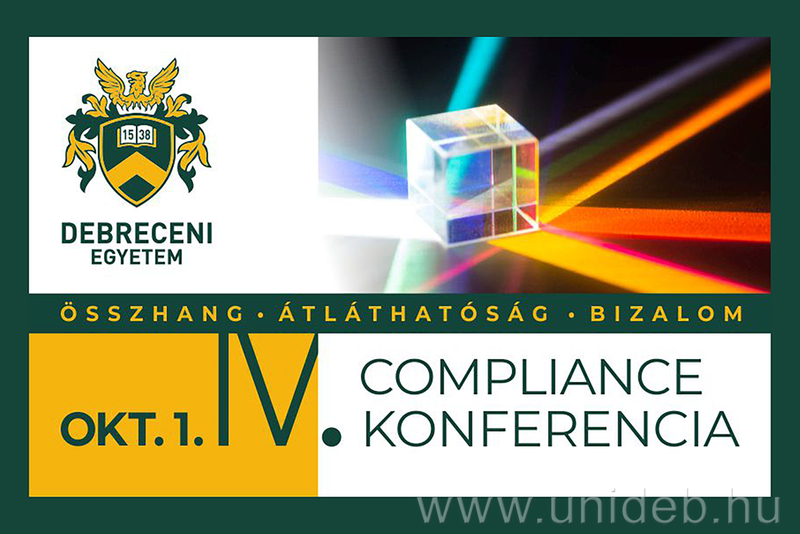
The University of Debrecen will host its fourth Compliance Conference this year. The professional event, scheduled for October 1, will focus on economic security, organisational resilience, the new EU anti-corruption framework, criminal law measures applicable to legal entities, as well as current issues surrounding artificial intelligence and data protection.
Organisations are facing rapidly changing regulations, economic uncertainty, technological risks and increasingly complex business relationships at the same time. These challenges do not arise independently: a data protection, procurement or corruption risk can quickly develop into operational, financial and reputational consequences. Compliance can therefore no longer be understood solely as adherence to legislation or as the responsibility of a single organisational unit. It represents a management and control approach that helps organisations identify risks in time, make responsible decisions and maintain operational continuity. This is also the guiding principle of this year’s University of Debrecen conference, which aims to present the future of compliance from a practical perspective.
Economic security and organisational resilience will feature prominently on the programme.
“Resilience does not simply mean that an organisation survives a crisis. It also means being able to identify vulnerable points in advance, prepare for change and make controlled and documentable decisions even in exceptional circumstances. Compliance has a strategic role in this process by connecting management responsibility, risk management, internal controls and organisational culture,” said György Kossa, senior executive and expert in economic security and resilience, who will examine these connections in his opening presentation in the changing risk environment.
“The aim is to demonstrate that compliance is not a brake on operations, but, when properly designed, one of the conditions for safe and sustainable operation,” added Zsuzsanna Herman, compliance lawyer and Compliance Director at the University of Debrecen. She will give a presentation on the new EU anti-corruption directive at the event.
The main deadline for transposing the directive into national legislation is June 1, 2028, while the detailed Hungarian rules related to its implementation are still being developed. Herman points out that the directive does not directly impose a general obligation on every organisation to introduce a compliance programme, but it clearly increases the importance of the field. Management and oversight, the handling of corruption risks, third-party due diligence, the investigation of reports and the ability to demonstrate the measures taken are all areas that organisations should already be reviewing.
The conference will also address criminal law measures applicable to legal entities.
“The operation or failure of a compliance system is no longer merely an organisational development issue in criminal proceedings. Under Hungarian law, we are not talking about the criminal liability of a legal entity as a perpetrator under the Criminal Code, but about a separate system of criminal law measures that can be applied to legal entities. In certain cases, it may be significant how management fulfilled its supervisory or control obligations and what measures the organisation took to prevent a crime and prevent its recurrence,” said attorney János Rausch, whose presentation will explain these connections.
“Taken together, the two presentations will explore how the actual operation of compliance can become a legally assessable and demonstrable factor,” Herman added.
The programme will offer practical guidance for organisations of different types and sizes. While there is no single model that can be applied unchanged to every organisation, there are common questions: where are the greatest risks, who makes and who reviews decisions, how are warning signs handled, and how well can these processes subsequently be demonstrated?
Barnabás Farkas, Head of the Integrity Department at OTP Bank, will use banking practice to demonstrate EU anti-corruption expectations and effective controls. Gábor Agócs, President of the Hungarian Chamber of Auditors, will focus on proportionate solutions that can also be implemented by small and medium-sized enterprises.
Norbert Vass, Head of the Digital Data Strategy Department at the National Authority for Data Protection and Freedom of Information, will examine current challenges related to artificial intelligence and data protection. Judit Firniksz, scientific adviser commissioned by Wolters Kluwer Hungary, and Edina Szólláth, compliance expert at Wolters Kluwer Hungary, will discuss the relationship between Compliance 4.0 and organisational adaptability.
The University of Debrecen is organising the professional conference for the fourth time this year.
“The University of Debrecen is a large and diverse institution encompassing education, research, patient care, innovation, economic cooperation and international relations. In such an environment, compliance is not an isolated control function, but a common language of responsible institutional governance. The university can provide a space for both academic approaches and the sharing of practical experience, which is why the conference is more than a series of presentations: it is a meeting point where corporate, institutional, legal, professional chamber and regulatory perspectives can engage in meaningful dialogue,” Herman said.
As in previous years, a panel discussion will provide an opportunity for participants to exchange views. The issues raised during the presentations will be examined from several professional perspectives, as management, economic security, auditing, the legal profession, whistleblowing, data protection and compliance experience in the financial sector each offer a different perspective on the same challenges.
The organisers welcome corporate and institutional leaders, lawyers, compliance and data protection professionals, internal auditors, statutory auditors, banking and insurance professionals, as well as those working in risk management, finance, HR, procurement and public procurement. University staff and students are also invited to attend.
The aim of the event is for participants to take away practical considerations and questions that they can apply within their own organisations. Compliance is a shared responsibility, but it can only work effectively when responsibilities, control points and decision-making processes are clearly defined.
The fourth Compliance Conference will be held on October 1, 2026, in the Aula of the Main Building of the University of Debrecen. The event’s patrons are György Kossa, former Chairman of the Board of Trustees of the István Gróf Tisza Foundation for the University of Debrecen, and Zoltán Bács, Rector of the University of Debrecen. Attila Péterfalvi, President of the National Authority for Data Protection and Freedom of Information, is the event’s patron.
University of Debrecen employees and students can attend the event free of charge with prior registration.
The conference is worth four credit points in both the Hungarian Bar Association and the Hungarian Chamber of Auditors’ accreditation systems.
The draft programme, registration details and further information are available on the conference website.
(unideb.hu)