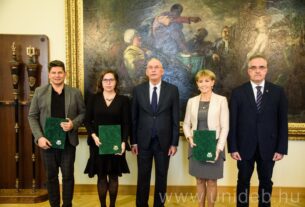








The University of Debrecen (UD) is planning new partnerships with universities and Hungarian teachers’ associations in neighbouring countries to share best practices and develop joint educational programmes. At the 28th National Conference of Public Education and Vocational Training Experts, held in Eger, university leaders discussed how the institution’s educational, research and professional expertise could better meet the needs of Hungarian higher education institutions and professional organisations beyond Hungary’s borders.
Supporting the next generation of teachers, improving the quality of Hungarian-language education and identifying opportunities for closer cooperation were the main objectives of the University of Debrecen’s participation in the professional conference.
During a roundtable discussion involving representatives of several Hungarian teachers’ organisations from neighbouring countries, university leaders discussed current challenges in teacher education, opportunities for developing professional training and ways to strengthen cooperation between higher education institutions.
Participants included the Association of Hungarian Teachers in Romania, the Forum of Hungarian Teachers in Croatia, the Association of Hungarian Teachers in North Bačka, the Association of Hungarian Teachers in Slovakia, the Hungarian Pentecostal Church, the Association of Hungarian Teachers in Vojvodina and the Transcarpathian Hungarian Teachers’ Association.
Veronika Fenyves, Vice-President for Education at the University of Debrecen, said that, after listening to the needs of these institutions, the university aims to establish closer partnerships than ever before with Hungarian-language educational institutions and organisations outside Hungary.
“Higher education for Hungarians living beyond the country’s borders plays a prominent role in the strategic objectives and responsibilities of the University of Debrecen. We have maintained relationships with higher education institutions in Transylvania and Transcarpathia for several decades. We consider it particularly important to cooperate and support one another in teaching, research and the training of future teachers. I hope that, building on the institutional and organisational experience we have gained, we can expand our existing network of relationships in the long term. To achieve this, we intend to initiate agreements with the institutions concerned that could help establish more stable communication and lead to more effective cooperation than ever before,” the Vice-President for Education explained.
Péter Forisek, Director-General of the University of Debrecen’s Teacher Training Centre, presented the university’s teacher education system and its achievements to date. He also highlighted the importance of extending the university’s already extensive network of international institutional partnerships to include teachers’ associations across the borders.
“We want to identify common ground between the University of Debrecen and institutions beyond Hungary’s borders in the fields of teacher education and professional development. Our firm objective is to give young people from Hungarian communities abroad the opportunity to study locally, without having to leave their hometowns. It is in our vital interest to preserve the Hungarian linguistic and cultural communities in the Carpathians, Transcarpathia, Upper Hungary and the Southern Region. The University of Debrecen is therefore striving to establish as many joint programmes as possible, building on a number of successful existing practices. For example, we maintain active professional relationships with Ferenc Rákóczi II Transcarpathian Hungarian University in Berehove and Partium Christian University, both of which actively participate in various university programmes,” the Director-General said.
Potential areas of cooperation with educational institutions and organisations beyond Hungary’s borders include professional development, talent management, supporting disadvantaged students, mental health and special education, teacher recruitment and training, career guidance, improving reading comprehension skills, further training programmes, locally delivered courses, mentoring schemes, support for local research groups and strengthening the region’s ability to retain its population.
As part of the conference, Rector Zoltán Bács also took part in a roundtable discussion on the conditions for social mobility and the operation of after-school learning centres. Speaking about the university’s social responsibility, he highlighted that approximately 7,000 students at the University of Debrecen come from disadvantaged settlements.
“Our regional position and the opportunities available to us create responsibilities in many areas. We want to give disadvantaged young people the opportunity to develop their talents and obtain a university degree. The university plays a key regional role in mentoring these young people, as well as in education and the economy. The current social support system lacks an institution capable of guiding young people throughout their educational and professional journeys, while also influencing parents and helping disadvantaged children reach university. The WorkStart programme could offer a solution. Through cooperation with BMW, secondary schools, vocational training institutions and the after-school learning centre network, we aim to promote employment opportunities,” the Rector added.
Erzsébet Gortka-Rákó, Dean of the Faculty of Child Education and Special Educational Needs at the University of Debrecen, also represented the institution at the professional conference, which featured twelve thematic sessions. She presented good practices developed by the faculty and the university in the fields of social pedagogy, community building and local support initiatives.
(unideb.hu)