








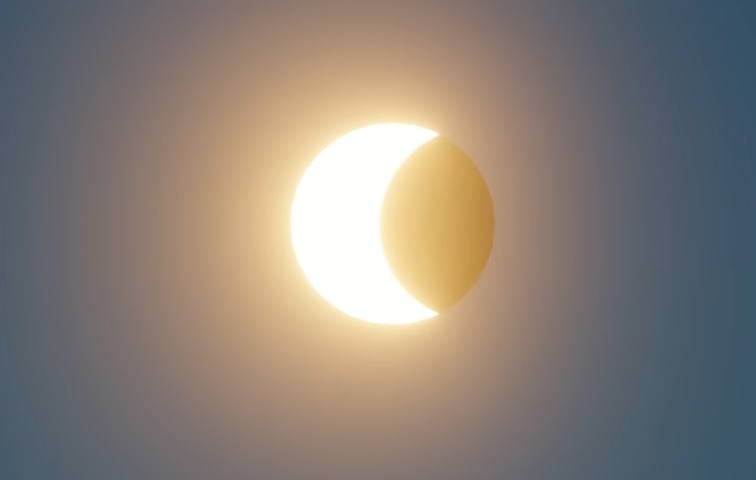
Experts have warned that it is strictly forbidden to watch the partial solar eclipse visible from Hungary in the early evening on Wednesday with the naked eye or inadequate equipment, as the phenomenon can cause permanent, irreversible vision damage or even blindness within just a few seconds.
According to a statement issued by the Svábhegyi Observatory on Wednesday, looking directly at the Sun is extremely dangerous even at sunset, when it is close to the horizon.
Only certified solar viewing glasses specifically manufactured for observing the Sun or astronomical solar filter film from a verified source should be used. If such equipment is not available, certified welding glass with a shade rating of at least DIN 15 provides adequate protection. Lower-rated welding glass, sunglasses, smoked glass, photographic film and CDs do not filter out harmful radiation and may therefore cause permanent eye damage.
The most important rule is that if the Sun appears uncomfortably bright when viewed through any device, observation should be stopped immediately.
The rare astronomical phenomenon will begin at 7:22 p.m. as seen from Budapest and will become increasingly spectacular as sunset approaches. In the capital, the Sun will set at 7:58 p.m., by which time the Moon will cover around 60 percent of the solar disk.
Solar eclipse 2026: This is how much of it will be visible from different parts of Hungary
The partial eclipse will be visible for longer and with a greater degree of coverage in western parts of the country because of the later sunset there than in eastern Hungary. For observation, it is advisable to choose a location free of obstacles such as buildings and trees – for example, a hilltop or waterfront – with a clear and unobstructed view towards the western horizon.
The most spectacular part of the eclipse will occur very low in the sky, close to the horizon. It is worth visiting hills or mountain peaks with an unobstructed western view, or completely flat areas of the Great Plain without rows of trees, well before sunset.
The sunset itself is what makes this partial solar eclipse particularly special. As the setting Sun’s light passes through a thicker layer of the atmosphere, it will gradually take on increasingly orange and reddish hues. At the same time, the Moon’s dark disk will cover an increasingly large portion of the Sun. Atmospheric refraction will slightly distort the image of the setting Sun into a flattened oval, meaning that the thick solar crescent will not have a regular shape: its upper tip will be slightly thinner, while its lower tip will be thicker.
For telescopic observation, only a factory-made solar filter specifically designed for solar observation and securely attached to the front of the telescope’s objective, or a Herschel wedge designed for refracting telescopes, may be used. Such equipment can also be purchased from specialist telescope shops. Looking directly at the Sun without an appropriate filter can cause permanent eye damage.
On this evening, a total solar eclipse will also be visible from several parts of the world. The path of totality will pass through Greenland, Iceland and parts of Spain. During a total solar eclipse, the Sun’s faint outer atmosphere, known as the corona, becomes visible. Hungary will lie outside the central path, in the Moon’s penumbra, so only a partial solar eclipse will be visible from the country.
According to the statement, however, people in Hungary will not have to miss out on the spectacle of totality. At the Svábhegyi Observatory’s Csillagkapu programme on August 12, the total solar eclipse in Spain can be followed via a live broadcast accompanied by expert commentary. The evening will be particularly special because several spectacular celestial phenomena will follow one another: alongside the solar eclipse, the peak of the Perseid meteor shower and Venus at dichotomy, or half phase, will also be observable during the night of August 12–13.
The last similarly spectacular sunrise involving an eclipsed Sun close to the horizon visible from Hungary occurred on May 31, 2003, when the partially eclipsed solar disk rose above the horizon. The next sunset featuring a similar solar crescent will take place on June 21, 2039, according to the statement.
(MTI)