






There are festival days that are remembered for the number of artists who take the stage, and then there are those that stay with you because of how they made you feel. Thursday, August 13, at Sziget was very much the latter.
With Paris Paloma, Lewis Capaldi and Florence + The Machine appearing on the same day, the festival offered an unexpectedly coherent emotional journey – from vulnerability and longing, through nostalgia and heartbreak, to catharsis and release.
Perhaps that is what made the day so memorable. These were three very different performances, yet each seemed to touch on the same question: what do we do with the feelings and memories that stay with us?
Paris Paloma opened that emotional journey from a deeply personal place. Her music carries a sense of vulnerability, longing and quiet strength, often turning intimate experiences into something much larger and more universal. There is softness in her songs, but also anger and resistance beneath the surface – a reminder that vulnerability does not necessarily mean weakness.
That connection to what is real and human was also present in Paloma’s words between songs. The singer has been outspoken about the growing presence of AI-generated content, making it clear that she does not want to embrace a world where human creativity and genuine artistic expression can simply be replaced by artificial content. Her 2026 song Miyazaki was itself described as an anti-AI anthem, built around the idea that the human impulse to create cannot simply be automated.
The same insistence on authenticity could be felt when she spoke about body image before Good Girl. Rather than allowing the body to become another standard by which people are measured, Paloma encouraged the audience not to judge or shame people based on how they look. It was a particularly fitting message for a song and performance that challenge the expectations placed on women and their bodies.
At a festival as large and restless as Sziget, that intimacy can feel particularly powerful. Surrounded by thousands of people, a song can suddenly become strangely personal, as if the crowd disappears for a moment and everyone is left alone with their own memories – and with the reminder that there is no single way a body, a face or a person is supposed to look.
For Paloma, vulnerability is therefore not something to hide. It is something to reclaim: the right to feel, to create, to exist in one’s own body and to remain human in a world increasingly shaped by artificial images and expectations.
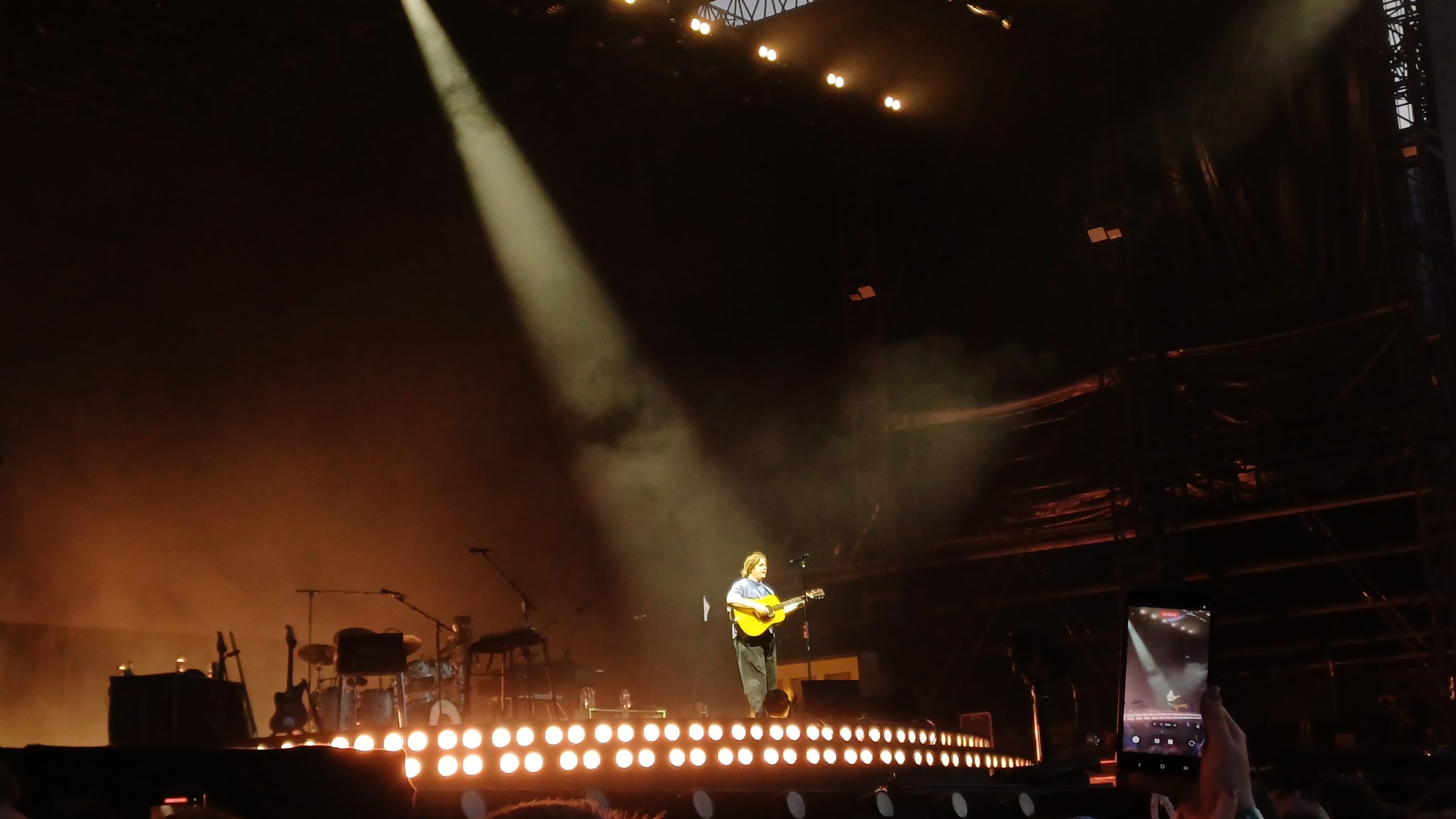
Then came Lewis Capaldi, returning to the Sziget stage with the kind of energy that made it clear how much he had been looking forward to being back. One of the most naturally funny and disarmingly down-to-earth performers of his generation, Capaldi spent much of the evening making the enormous crowd laugh almost as easily as he made them sing.
But beneath the jokes, there was a much more personal story behind his return. Before performing The Day That I Die, Capaldi spoke openly about the difficult two years he has been through – a period that forced him to step away from touring and focus on his mental health. His return to the stage therefore felt like more than simply another concert: it was a reminder of how far he had come.
That honesty made the emotional moments of the show hit even harder. Capaldi has always had a remarkable ability to turn heartbreak, uncertainty and vulnerability into songs that thousands of people can make their own. Yet this time, the audience was also hearing those songs from an artist who had lived through his own difficult chapter and was now standing on stage again, clearly happy to be there.
And there was something particularly fitting about that on his third appearance at Sziget. The festival itself is built around returning – coming back to the same island, hearing familiar songs and meeting old memories, while knowing that neither the artists nor the people in the crowd are quite the same as they were before.
Capaldi also gave the audience something to look forward to beyond this year’s festival. Once the current touring period is over, he will move on to work on his next album – a prospect that made the Sziget crowd even more eager for whatever comes next.
But before leaving the stage, Capaldi delivered the moment many in the crowd had been waiting for. He closed the concert with his global classic Someone You Loved, turning Sziget into one enormous singalong. By then, the jokes had given way almost entirely to raw emotion, and there were few dry eyes in the crowd.
It was a deeply heartfelt performance of a song that has become a soundtrack to heartbreak and memories for millions of people. Hearing thousands of voices sing it back to Capaldi made the farewell feel especially powerful – a shared moment of nostalgia, emotion and release.
And then, as the night moved towards its climax, Florence + The Machine transformed that nostalgia into something much bigger.
Florence’s second appearance at Sziget brought a different kind of emotional intensity. Where Paloma invited the audience inward and Capaldi encouraged them to look back, Florence seemed to ask them to let go.
Her performances have always carried a sense of theatricality, spirituality and transformation. The emotions are not kept quietly inside; they are released through movement, music and collective energy. Florence Welch has a unique ability to turn a concert into something that feels almost ritualistic – a space where thousands of people can experience the same emotion at the same time.
And by the end of the show, one of Florence’s now emblematic concert traditions made its return: the crusade against phones.
Before Dog Days Are Over, Welch stopped the band and asked the audience to put their phones away. She acknowledged that it was not an easy request to make before such a beloved hit, but argued that screens can make us lose sight of the very reason we came to a concert in the first place.
It was perhaps the perfect ending to an evening built around emotion.
After Paris Paloma’s reminder of the importance of authenticity and embracing ourselves, and Lewis Capaldi’s deeply personal journey through heartbreak, memory and recovery, Florence was asking the audience to do one final thing: be present.
For those final moments, there was nowhere to hide behind a phone screen. No need to record the moment, post it or watch it back later. The only thing left was the music, the people around us and whatever emotions the songs brought to the surface.
And perhaps that was exactly what the evening had been building towards all along. Not capturing the feeling, but actually feeling it.
On Thursday, August 13, those emotions seemed to form a natural progression.
Paris Paloma made us feel.
Lewis Capaldi made us remember.
Florence + The Machine made us let go.
From vulnerability to nostalgia, from heartbreak to hope, the three performances offered different ways of processing the emotions we carry with us.
And perhaps that was the real story of Thursday at Sziget. Not simply three major concerts, but three different moments in the same emotional journey – looking inward, looking back, and finally letting go.
For a few hours on Óbuda Island, thousands of people were not just listening to music. They were remembering who they had been, feeling what they had carried with them, and, together, finding a reason to let some of it go.