






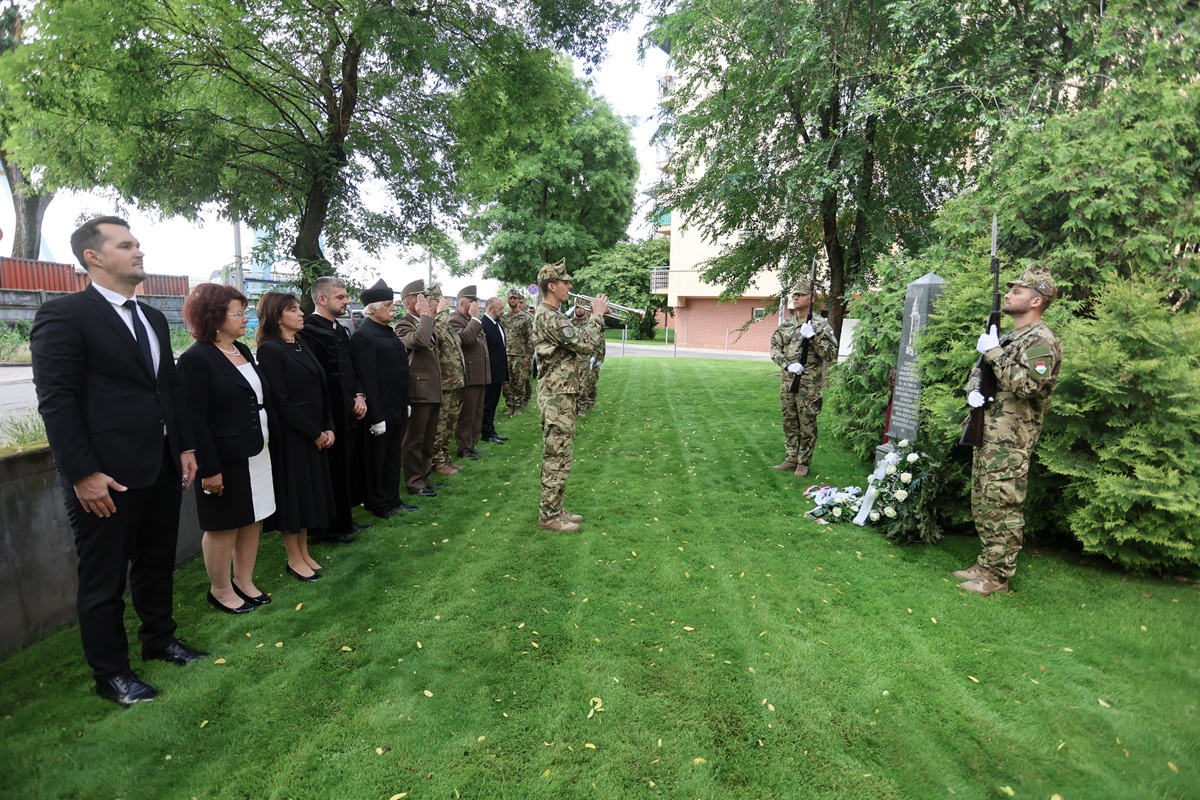
On 2 June 2026, wreath-laying ceremonies were held by the Municipality of Debrecen (Debrecen County Right City) in memory of the victims of the 1944 carpet bombing of Debrecen. The commemorations took place at the memorial of the city’s fallen heroes and civilian victims on Medgyessy Promenade, at the memorial plaque on the wall of the Great Station (Nagyállomás) building, and at the memorial of the Ispotály Church.
Deputy Mayor István Puskás recalled at the ceremony that 2 June 1944 began as an ordinary weekday morning, when air-raid sirens sounded shortly before 9 a.m. He said this was a routine occurrence at the time, as the air defence system regularly warned of wartime danger. However, on this occasion it was a real threat: Allied bombers had reached Debrecen. Looking back on the events, the deputy mayor said the people of Debrecen were unprepared for the attack, and by the time the nearly 200 aircraft—130 bombers and their escort fighters—became audible, it was already too late for many to seek shelter.
Around one thousand bombs fell on the city of Debrecen. The area around the railway station suffered the greatest destruction, as it was the primary target of the attack, but the railway repair shop, the wagon factory and their surroundings, as well as large parts of the city centre, were also heavily hit, causing massive devastation. Hundreds of residential buildings were destroyed and many more became uninhabitable or severely damaged; even the roof structure of the Great Church sustained serious damage. According to the deputy mayor, this refers only to material losses—far more importantly, 1,200 residents of Debrecen or people from nearby areas working in the city lost their lives that day, and hundreds were injured. He described the attack as the most devastating air raid in Hungary during the Second World War.
He emphasized that the city still bears the scars of this terrible destruction to this day, as an enduring memorial. The beautifully renovated park at Petőfi Square is in fact a wartime memorial. He noted that until 2 July 1944, a beautiful turn-of-the-century district stood there, with hotels, public buildings, private homes, and even the former building of the railway station, which also suffered damage.
He stressed that it is a shared responsibility for present generations to preserve these memories, not only to pay respect to those whose homes, churches, and livelihoods were destroyed, but above all to remember those who lost their lives in the ruins and the fire. He added that remembrance must also include the lessons learned.
He urged that the memory and lesson of the tragedy be carried forward: that every destruction begins on a seemingly peaceful day, and every tragedy can emerge from an ordinary weekday. It is a shared responsibility to ensure that peaceful everyday life is never broken again, neither in Debrecen nor in Hungary.
The day, he said, is indelibly written in black letters in the history of Debrecen. This was also emphasized by Hajnalka Eszenyiné Harascsák, head of Debrecen Post Office 2. She noted that nearly one thousand bombs fell on the railway station and its immediate surroundings. In just two hours, more than 1,200 people lost their lives, families were torn apart, and the city was reduced to ruins. She said they had gathered to bow their heads before the victims and to remember those heroes who, not as soldiers but while carrying out their everyday duties, became victims of the war machine.
Recalling the morning’s events, she said that although the roar of bombers could already be heard, postal and railway workers in Debrecen remained at their posts. They did not flee. They operated telegraphs, sorted mail, and maintained connections with the outside world to ensure railway operations. They served their duties until the very last moment. Nearly one hundred railway and postal workers died in the ruins, where they had been working only a quarter of an hour earlier. Their memory serves as a reminder that peace is not a given, but the greatest treasure that must be protected.
The commemoration concluded at the memorial of the Ispotály Church, where participants also laid wreaths.
Photo: debrecen.hu