








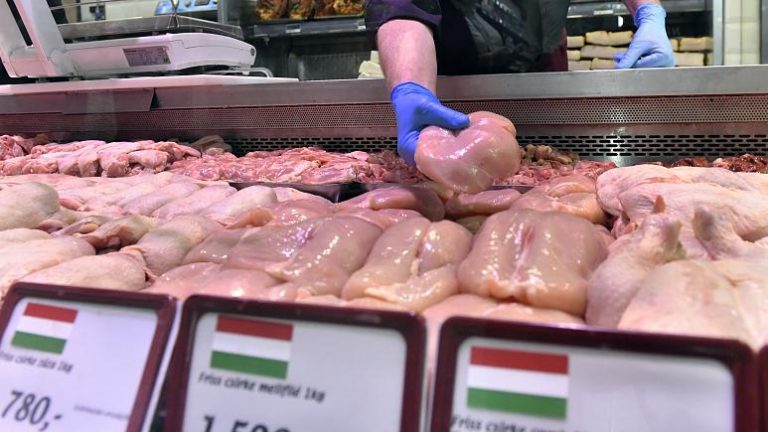
The reduction of retail margins has significantly contributed to lowering inflation and keeping prices under control. The government will continue its fight against price increases and will therefore extend the retail margin reduction measure until the end of May, the Ministry for National Economy (NGM) announced in its commentary on the latest price statistics.
The government is taking action against price hikes across all sectors and has negotiated voluntary price caps with banks, insurance companies, telecommunications firms, and pharmaceutical industry players as well.
In addition, the government has once again made it possible to purchase cold food items with the SZÉP card until April 30, 2026, the ministry recalled.
In its statement, the ministry emphasized that, unlike the Tisza Party, the government stands with Hungarian people rather than multinational corporations and is doing everything possible to ensure that families and pensioners have more money in their pockets.
To this end, the government is raising wages (for example, an 11 percent increase in the minimum wage and sector-specific wage increases), protecting the 13th-month pension and introducing a 14th-month pension; reducing taxes (such as tax exemptions for mothers under 40 with two children and doubling the family tax allowance); and continuing the fight against price increases through the retail margin reduction, the NGM listed.
The statement recalled that, according to data from the Hungarian Central Statistical Office (KSH), inflation in January 2026 stood at 2.1 percent compared to the same period a year earlier, and 0.3 percent compared to December.
Food inflation was 1.3 percent year-on-year and 0.6 percent month-on-month. Within this category, prices of cold food products — excluding catering services — decreased by 2 percent compared to the same period in 2025 and rose by just 0.4 percent compared to the previous month.
The NGM highlighted that from December 1, the government extended the retail margin reduction to an additional 13 product categories, resulting in lasting and substantial price decreases. According to calculations, the product categories brought under the measure on March 13, 2025 saw an average price decrease of 23.4 percent.
As of December 1, 2025, the scope of the retail margin reduction was expanded to 13 new food product categories. Available data show that by January 12, 2026, prices of the affected products had fallen by an average of 22.6 percent. In the case of drugstore products, data collection indicates an average price decrease of 29.1 percent for products covered by the measure, the NGM said.
(MTI)