








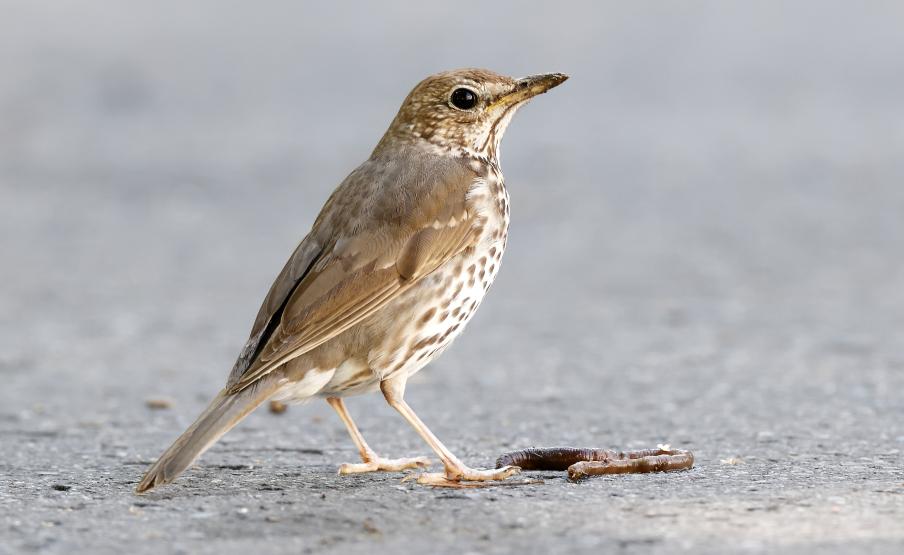
The song thrush has been named Bird of the Year 2026 in Hungary following the results of a public online vote, the Hungarian Ornithological and Nature Conservation Society (MME) told MTI on Monday.
As noted in the statement, the MME launched its “Bird of the Year” program in 1979 with the aim of raising public awareness of bird species or groups affected by conservation issues.
The statement highlighted that the song thrush is smaller than the common blackbird, with males and females looking alike. Their upperparts are olive-brown, with a whitish throat, while the breast, belly and flanks are yellowish-white with brown spotting. The wing and tail feathers are dark olive-brown, and the underwing coverts, visible in flight, are yellowish in color.
One of the species’ most distinctive features is the male’s song, considered among the most beautiful in Europe. The song thrush is native to Eurasia, but early European settlers introduced it to Australia and New Zealand. In Hungary, it is widespread and is the second most common thrush species after the blackbird.
Its original habitat consists of deciduous, mixed and coniferous forests with dense undergrowth. In recent decades, however, the species has increasingly moved into urban areas in Hungary as well, making it more common in gardens and parks. It feeds on invertebrates, including earthworms and arthropods, consuming many caterpillars. It often cracks snails on the same hard surface, usually a stone, known as a “thrush anvil.”
The song thrush can breed twice a year. It builds a classic cup-shaped nest from dry plant stems and small twigs in trees and shrubs. A unique feature of the nest is its inner lining, which the female smooths with decayed wood mixed with saliva.
With the exception of the southernmost populations, the species is migratory, spending the winter in southern Europe, North Africa and the Middle East. Among urban populations, overwintering is becoming increasingly common, primarily in Western Europe and now also in Hungary. The global, European and Hungarian populations—estimated at 342,000 to 357,000 breeding pairs in Hungary—show a stable or increasing trend.
Due to its migration toward the Mediterranean regions of Europe, North Africa and the Middle East, the species is also affected by the longstanding tradition of bird trapping and hunting in these areas, estimated at around 25 million birds annually. In Hungary, tree and shrub cutting during the breeding season may also affect song thrushes. The operation of year-round water sources and bird baths recommended by the Bird-Friendly Garden program also helps support the species.
Photo: MME / Zoltán Orbán