








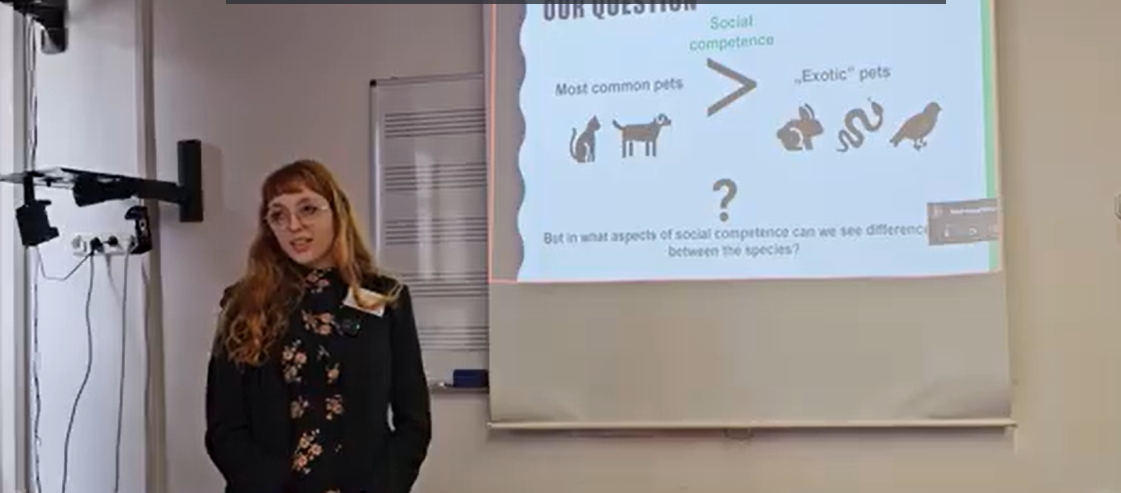
In her recent presentation, Zoller Kata Zsófia, assistant professor at the Department of Social Sciences, explored human-directed social competence across various pet species. Her research aimed to determine how different animals respond to social cues from humans and what this reveals about the human-animal bond.
Social competence, defined as an individual’s ability to optimize social behavior based on available social information, is thought to be evolvable and variable, with direct implications for fitness. Zsófia hypothesized that the pets most commonly kept for companionship—dogs and cats—would demonstrate higher social competence in tasks involving human interaction compared to exotic pets such as small mammals, reptiles, and birds.
The study tested 62 pets, divided into five groups: dogs, cats, parrots, small mammals, and reptiles. Using a combination of online platforms like Zoom and Google Meet, the team conducted 11 subtests divided into “in-cage” and “out-of-cage” parts, measuring a total of 45 behavioral variables.
Key findings included:
-
Separation Test: Dogs and cats spent significantly more time oriented toward and near the door when the owner left, compared to small mammals and reptiles, demonstrating stronger attachment behaviors.
-
Affiliation Test: Reptiles tolerated owner interactions more readily than parrots and cats, though dogs showed the highest overall orientation toward the owner during active engagement.
-
Recall Test: Dogs approached the owner more quickly than other species when called using verbal commands or attention-grabbing noises. Cats also responded faster than small mammals and reptiles.
-
Command Test: Dogs demonstrated the highest trainability, performing commands with increased attention to the owner compared to other species.
Overall, the study showed that dogs and cats exhibit stronger attachment and affiliative behaviors toward their owners, as well as higher responsiveness to training and social cues, compared to small mammals, reptiles, and birds. Parrots showed intermediate responses, while reptiles were more passive and tolerant but less socially engaged.
Zsófia also noted the influence of owner expectations on the results: many small mammals had limited prior training or interaction expectations, which may have affected their performance. Her study concludes that for individuals seeking emotional bonding and interactive engagement, dogs and cats are the most suitable pets. Conversely, smaller or less socially interactive animals may be ideal for owners who prefer low-maintenance companionship.
This research provides valuable insights into how species-specific social competence shapes human-pet relationships, highlighting the importance of considering both animal behavior and owner expectations when choosing a pet.