







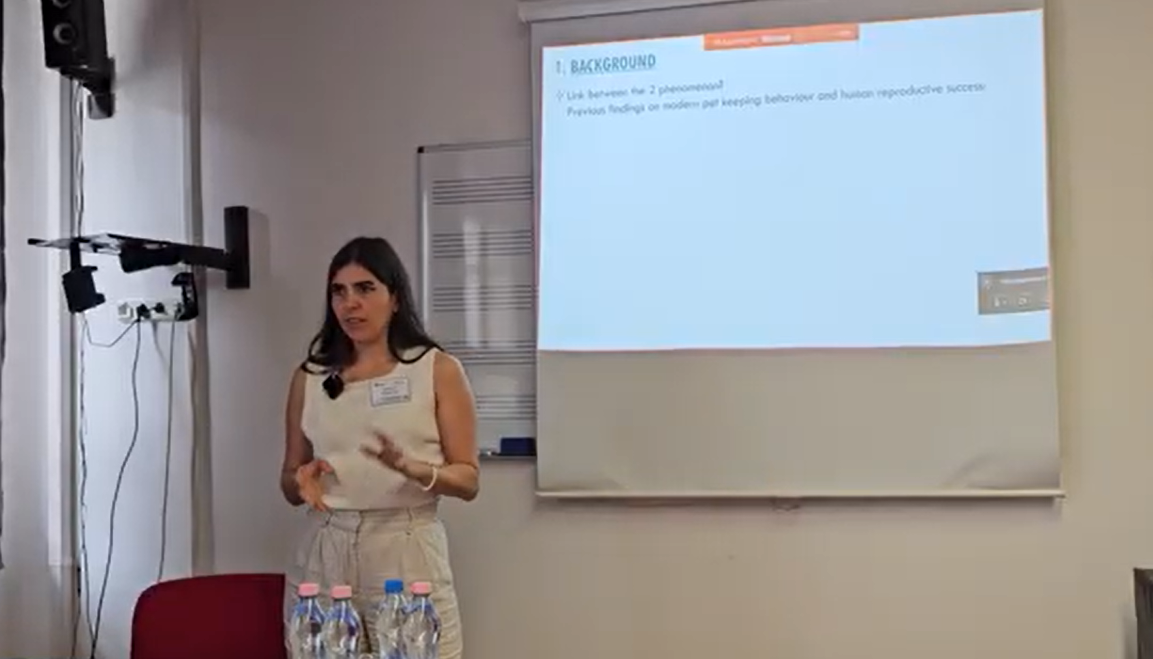
In her recent presentation, PhD student Laura Gillett from the Department of Ethology at EL University examined how caregiving roles in human households influence attitudes and behaviors toward pets. Her research shows that it is not simply being a parent that predicts how people care for pets, but the degree of active involvement in child care.
Gillett traced the history of pet keeping, noting that before the Industrial Revolution, animals were primarily valued for economic purposes and pet ownership was largely a privilege of the wealthy. Over time, companionship functions grew, particularly in Western societies, coinciding with declining fertility rates. Today, pet ownership has become increasingly popular, often serving as an alternative or complement to human child-rearing.
Analyzing a representative sample of Hungarian adults, Gillett identified four social-demographic profiles: seniors, empty nesters, young adults without children, and parents of young children. Her findings reveal distinct patterns: parents of young children tend to own more pets overall and show species preferences aligned with family needs (e.g., dogs for active families, cats for urban young adults). However, these parents also report more challenges in balancing pet care with childcare responsibilities and place relatively less emotional importance on pets compared to household members.
Why some adults choose pets over children: Insights from Laura Gillet’s research
Conversely, adults without regular child care responsibilities often invest more emotionally, financially, and in time toward pets. For them, pet caregiving serves as a meaningful outlet for nurturing behaviors, sometimes functioning as a substitute for child-rearing. Pets in these households are often perceived as highly important, sometimes even more so than humans in their social network.
Gillett concludes that the relationship between pet ownership and human fertility is indirect. Pet care practices are shaped by the availability of nurturing targets in the household: when children are absent, caregiving is redirected toward pets; when children are present, pets take on complementary roles, supporting child development and family cohesion rather than replacing children.
Her study highlights how modern pet keeping reflects broader social and demographic trends, showing that caregiving behaviors, rather than parental status alone, determine attitudes toward and investment in pets.