






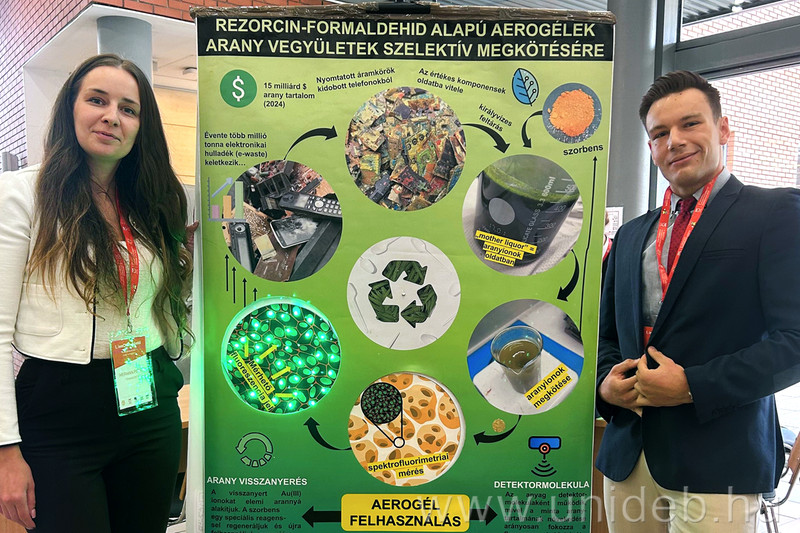
In both the figurative and literal sense, the discovery of young researchers at the University of Debrecen is worth its weight in gold. Balázs József Bukta and Petra Herman have developed an aerogel that enables the recovery of precious metals from electronic waste in the most efficient and sustainable way to date. It’s no surprise that this scientific result — now in the process of being patented — won the Grand Prize at the first innOTDK competition.
Balázs József Bukta is a master’s student in chemical engineering at the Faculty of Science and Technology of the University of Debrecen. As a member of the Institute of Chemistry’s Aerogel Research Group, he began the scientific work two years ago that led the university’s Research Utilization and Technology Transfer Center to file a patent application.
“Although there were already methods to recover gold from electronic waste, our technique is much more efficient — we can bind a higher quantity of precious metal, and most importantly, we do it in a cheap and environmentally friendly way,” explained the chemical engineering student, who developed the idea together with his supervisor, Petra Herman.
“Balázs participates in several talent development programs, and he approached this research with great diligence and motivation. He carried out every experiment himself, needing only minimal guidance to develop a truly innovative and sustainable solution,” said the assistant professor at the Department of Inorganic and Analytical Chemistry.
With his project titled Resorcinol-formaldehyde based aerogels for the selective binding of gold compounds, Bukta won a special prize in April at the 37th National Scientific Students’ Associations Conference (OTDK), and later entered the first innOTDK as well. The competition was launched to provide mentoring and financial support to the authors of the best projects containing innovative elements, helping them to realize their research results in practice.
Out of 80 entries, 28 projects reached the finals. The young researchers presented their work briefly, after which the professional jury selected the nine most promising projects to compete for the innOTDK Grand Prize and the innOTDK Award. “The projects that reached the finals represented outstanding scientific quality and high implementation potential. Our goal with this competition is to encourage more young researchers to adopt this approach in their work,” emphasized László Mátyus, Dean of the Faculty of General Medicine at the University of Debrecen and the incoming president of the National Scientific Students’ Associations Council (OTDT).
“The success of our students clearly shows that we have managed to strengthen the application-oriented and practical approach alongside our traditionally high-level basic research. It is especially gratifying that our talented young researchers not only work with scientific rigor but also boldly open toward industrial and social utilization, setting an example for our entire community,” added Ferenc Kun, Dean of the Faculty of Science and Technology, in connection with Bukta’s innOTDK Grand Prize win.
The young researcher’s project was presented to the jury as a laboratory-developed solution, but the work is far from over — he is already preparing, through an international collaboration, to examine the industrial applicability of the innovation. He also plans to develop new gels capable of extracting valuable rare earth elements from various waste materials.
– University of Debrecen Press Center –