








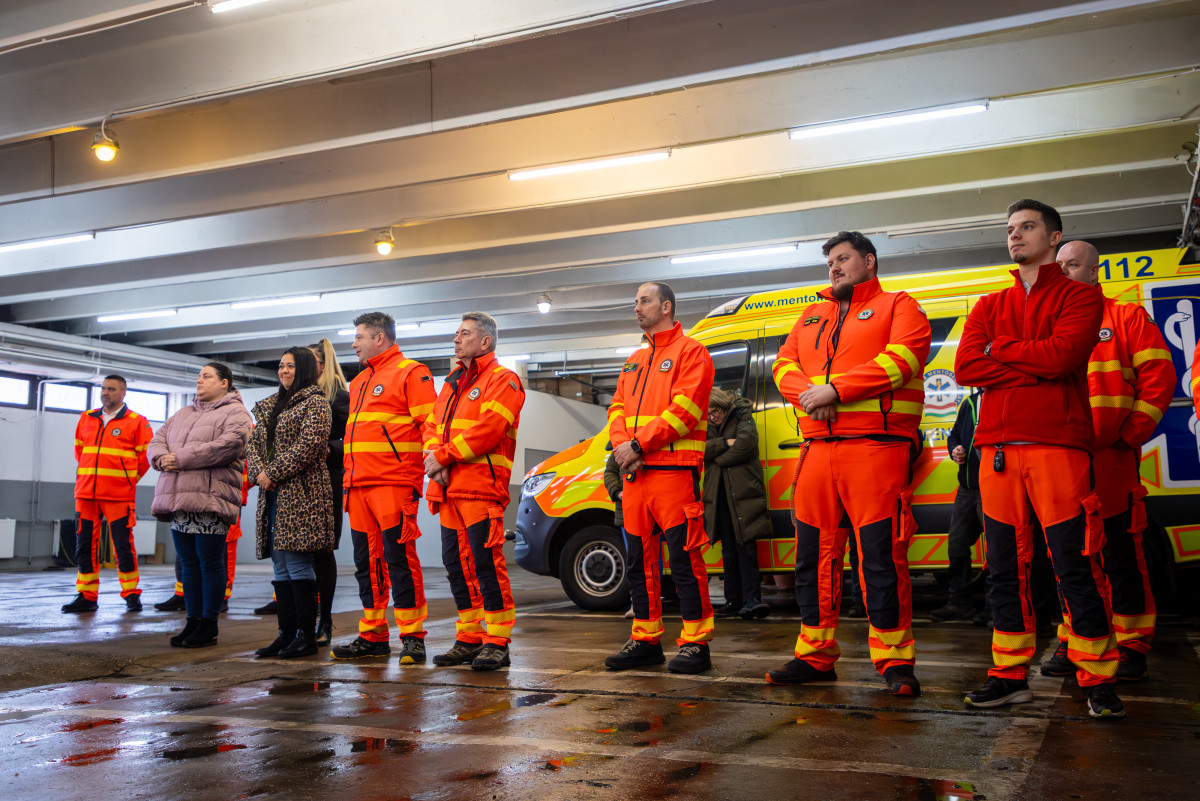
Two new emergency vehicles have arrived at the Debrecen Ambulance Station. A “Heavy Duty” Mercedes-Benz Sprinter 417 CDI rapid-response ambulance and a MAN TGE 4.160 ambulance— the latter of which will also serve at the Hajdúsámson Emergency Response Point established exactly ten years ago—were officially handed over on February 4, 2026.
At the event, Dr. Gábor Csató, Director General of the National Ambulance Service, recalled that when 101 new ambulances were procured last year with nearly HUF 9 billion in government funding, it was clear that some of these vehicles would be allocated to Hajdú-Bihar County, including Debrecen. The Debrecen station is the largest ambulance station in Hungary in terms of staff numbers, vehicles in operation, and volume of tasks performed. Dr. Csató emphasized that the procurement of these new ambulances represents only one milestone on a longer journey, as hundreds of ambulance units have been replaced in recent years, and additional procurements are already planned for this year as well.
The new vehicles deployed in Debrecen and Hajdúsámson, staffed by highly trained professionals, are capable of providing the highest level of care whenever needed. At the same time, the Director General expressed his hope that these vehicles will spend as much time as possible in the garage—since that would indicate fewer people in need of emergency assistance. Of course, reality often proves otherwise: the harsh weather conditions of recent weeks have resulted in a 20 percent increase in ambulance workloads nationwide compared to typical seasonal levels, and nearly 17,000 colleagues rose to the challenge. Dr. Csató concluded by thanking the government for its support, his colleagues for their dedicated work, and the patients for recognizing that the ambulance service performs its duties well.
Dr. Diána Széles, Deputy Mayor of Debrecen, emphasized that while the handover of new equipment is a cause for celebration, the true significance of the occasion lies in honoring the paramedics who respond to the very first call, who go out to patients every day, who provide safety to the people of Debrecen, and on whom the city can always rely. According to the Deputy Mayor, taking into account the reorganization of the on-call system, Debrecen’s ambulance service handles a total of around 50,000 cases annually, encountering patients and people in distress that many times each year.
They are supported by outstanding professional expertise and— as demonstrated by the new ambulances—an increasingly modern technical background. This technical infrastructure not only ensures higher-quality patient care but also makes the work of paramedics more efficient and, in some respects, easier. For example, the newly delivered vehicles include equipment that makes patient movement significantly easier than before. Dr. Széles also noted that the government has recognized the importance of healthcare workers by implementing wage adjustments and providing a genuine career path for those who dedicate their lives to this profession and service.
Everyone who contributes to healthcare deserves recognition. The effective operation of healthcare requires exemplary cooperation among the state, local governments, economic stakeholders, and healthcare professionals—and this cooperation exists in Debrecen. In this context, Dr. Széles expressed her hope that the long-running, gradual renovation and modernization of the Debrecen Ambulance Station will continue through joint efforts, enabling staff to carry out their daily work in increasingly high-quality conditions. This, too, forms part of the appreciation and recognition owed to paramedics.
As recalled by Szabolcs Antal, Mayor of Hajdúsámson, the Hajdúsámson Emergency Response Point began operations on March 1, 2016. As such, the delivery of the ambulance that will also serve in Hajdúsámson is considered a 10th birthday gift to the town. While it was not yet known in 2016 how important the response point would become, the fact that in 2025 it handled more than 1,400 cases and that the stationed vehicle covered over 90,000 kilometers clearly demonstrates the essential role it plays in ensuring safe and professional emergency care for Hajdúsámson, its surrounding area, and neighboring settlements.
The mayor highlighted that the contrast between the new ambulances and the older white Nysa ambulance visible in the background vividly illustrates how far the National Ambulance Service has progressed over three to four decades in terms of technical conditions. Based on the medical and rescue technology equipment included in the new vehicles, Antal Szabolcs described the National Ambulance Service as one of the most innovative healthcare institutions in Hungary, adding that these ambulances would meet the highest standards anywhere in the world.
However, all of this equipment and infrastructure would be meaningless without dedicated, highly skilled professionals to operate them. Antal Szabolcs also expressed his gratitude for the selfless work of paramedics, adding that public perception consistently ranks paramedics and firefighters among the most respected professions providing a sense of security—an appreciation earned solely through their own efforts.
The new ambulances were presented to guests under the guidance of Dr. Ferenc Korcsmáros, Director of the Northern Great Plain Regional Ambulance Organization of the National Ambulance Service. Currently, 220 people work at the Debrecen Ambulance Station, which operates a total of 16 ambulances and one mass-casualty response unit. In terms of equipment, the new Mercedes-Benz Sprinter 417 CDI rapid-response vehicle can essentially be considered a mobile intensive care unit, staffed accordingly by a specialist physician, a qualified nurse, and an ambulance driver who is also a certified nurse. The MAN TGE 4.160 ambulance is equipped differently but is still suitable for direct life-saving interventions, as it includes, among other things, resuscitation equipment.
(debrecen.hu)
Photo: debrecen.hu