







The hyper-modern museum impressed the professional audience at MIPIM, the world’s most important real estate exhibition.
The visual designs and presentation video of the new Hungarian Natural History Museum exhibition building being constructed in Debrecen were presented to an international audience at MIPIM in Cannes, the world’s largest real estate and urban development event.
The international professional audience received the project with great interest. The complex was designed by the world-renowned Bjarke Ingels Group and the Hungarian Vikár and Lukács Architectural Studio. According to several experts, the iconic concept could follow the recent international successes of Hungarian museum architecture, such as the House of Hungarian Music and the Museum of Ethnography in Budapest, both of which have won numerous prestigious international architectural awards.
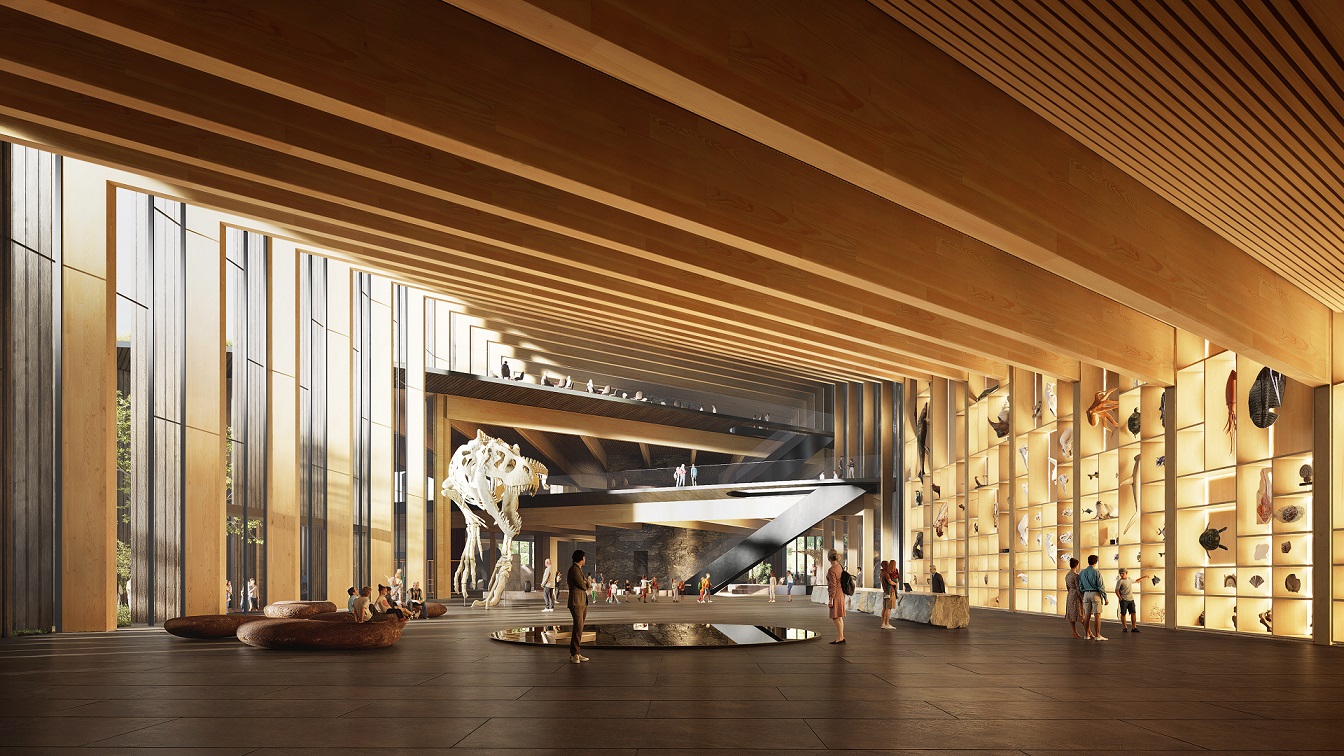
In the newly released video, viewers can virtually explore the museum of the future, which will become a spectacular new meeting point of nature and science in Debrecen.
The hyper-modern museum complex will allow the Hungarian Natural History Museum’s collection of more than 11 million items—of invaluable scientific importance—to be displayed, stored, and researched under world-class conditions. The project aims to create a science-based experience center capable of attracting hundreds of thousands of visitors every year.
Debrecen Project Presented at the Hungarian Pavilion
The Debrecen Natural History Museum project was showcased at the Hungary stand at MIPIM in Cannes. Hungary’s participation was organized by the Real Estate Developers Roundtable Association and the Hungarian Investment Promotion Agency.
The museum development fits well into MIPIM’s central themes, which focus on the reuse of urban spaces, technological innovation, and sustainable urban environments.
The iconic exhibition building, designed by the internationally renowned Danish Bjarke Ingels Group (BIG) together with Vikár and Lukács Architectural Studio, will function simultaneously as:
-
a museum
-
a scientific center
-
an ecological symbol
-
a community space
It will present the relationship between nature and humanity in a completely new dimension.
Supported by the Government of Hungary, the project is one of the country’s largest cultural and scientific investments. It will not only preserve Hungary’s largest national natural science collection but will also present it to the public in a new interactive and experience-based form.
The project will elevate Debrecen into a leading natural science center in Eastern Europe and an important regional tourism and cultural hub. With modern exhibition spaces, scientific programs, green community areas, and family-friendly services, the complex is expected to attract hundreds of thousands of visitors annually.
Animation Film Introduced at MIPIM
An impressive animated film was also created to present the project and debuted at MIPIM.
The video takes viewers on a virtual walk through the building, showcasing:
-
the green roof
-
exhibition halls
-
community spaces
-
and how the building will connect with the surrounding Nagyerdő forest area.
“A New Chapter in Hungarian Museum Architecture”
Ferenc Kun, CEO of Debreceni Infrastruktúra Fejlesztő, the organization responsible for implementing the project, stated:
“We successfully presented the plans for the exhibition building and collection center of the Hungarian Natural History Museum in Debrecen at the world’s most important international real estate event. The museum of the future will further increase the city’s attractiveness and open a new chapter in Hungarian museum architecture as an iconic landscape element. It will reach not only Hungarian visitors but also people from the Partium region of Romania, Transcarpathian Ukraine, and eastern Slovakia.
Debrecen will become not only one of Hungary’s scientific strongholds but also a cultural hub for the Eastern European region. The center of Hungarian nature will be built in the center of Debrecen’s natural environment.”
He emphasized that the city’s scientific base, university background, and cultural infrastructure strongly support the project and will help position Debrecen as a competitive cultural center both nationally and internationally.
A Museum That Gives the Forest Back
The new Natural History Museum in Debrecen will not only be built sustainably but will also actively contribute to the ecological renewal of the Nagyerdő forest.
The 23,000 m² complex, built on the site of the former Oláh Gábor Street stadium, will include a large internal garden. Its green roof, covered with native plants, will naturally extend the forest’s canopy.
The building’s shape and mass integrate organically into the surrounding landscape, minimizing visual impact while encouraging the return of local wildlife and vegetation.
Located near Nagyerdő and the Hortobágy UNESCO World Heritage site, the museum will offer a unique opportunity to combine:
-
nature conservation
-
education
-
scientific research
The complex will include exhibition spaces, a visitor center, researcher accommodations, operational facilities, and parking.
The institution aims to become a center for environmental awareness, combining science communication, community experiences, and sustainable development.
A New Era in Natural Science Education
The collection of the Hungarian Natural History Museum is the largest natural history and anthropological collection in the Carpathian Basin, containing more than 11 million natural specimens, including 360,000 species.
Zsolt Bernert, Director General of the museum, stated:
“The new exhibition building will be uniquely designed to meet the museum’s needs and fully support its educational and research activities while functioning in harmony with the natural environment.
The presence of the university in Debrecen guarantees a continuous supply of professionals and provides an exceptional scientific community and professional support system.”
This cooperation will provide unique opportunities for students, researchers, and the museum itself, ensuring the institution operates at the highest professional standards in the long term.
Current Location of the Museum
At present, the Hungarian Natural History Museum welcomes visitors in Budapest, in the former Ludovika Military Academy complex.
Visitors can see:
-
unique Hungarian dinosaur fossils and reconstructions
-
exhibitions on the wildlife and minerals of the Carpathian Basin
-
interactive preparation demonstrations
-
museum education programs.
Experience and Community for Everyone – The Open Museum of the Future
The new museum will be more than an exhibition space; it will function as an open, lively community hub offering experiences for all ages.
The indoor and outdoor areas will be closely integrated and will include:
-
a roof garden
-
thematic playgrounds
-
interactive installations
-
an outdoor stage
These spaces will serve families, school groups, tourists, and scientific communities alike.
The building’s entrance hall and garden will function as open meeting places accessible even outside opening hours, turning the museum into a new type of community space in the heart of Debrecen.
Strong Public Support
According to a representative survey conducted by Debreceni Infrastruktúra Fejlesztő:
-
90% of Debrecen residents support the project
-
91% like the visual design plans
Residents are pleased that the Kultúrpark and Nagyerdő area will gain a new scientific and green center.
Two-thirds of respondents believe Hungary would lose an important opportunity if the nationally significant museum designed by the famous Danish architectural firm were not realized in Debrecen.
To help the public understand the project, a scale model of the building will be displayed in a free exhibition.
World-Class Architects Competed for the Project
The international architectural competition for the museum attracted leading firms such as:
-
Zaha Hadid Architects
-
Sauerbruch Hutton
-
3XN (Denmark)
These studios are responsible for iconic buildings like:
-
MAXXI Museum in Rome
-
M9 Museum in Venice
-
Cube Berlin
The winning concept was created by Bjarke Ingels Group (BIG) together with Vikár and Lukács Architectural Studio.
BIG, with more than 700 employees, is one of the most progressive architectural studios in the world, known for projects such as:
-
LEGO House
-
VIA 57 West in New York
-
Sluishuis in Amsterdam
Their designs combine innovation, playfulness, and ecological thinking.
The Hungarian partner Vikár and Lukács Architectural Studio has been a key figure in contemporary Hungarian architecture for over two decades, known for projects characterized by environmental sensitivity, high architectural quality, and functional innovation.
The competition aimed not only to select the best design but also to ensure that the new Debrecen museum becomes a prominent landmark on the international architectural map—a goal that experts believe the winning concept will successfully achieve.