







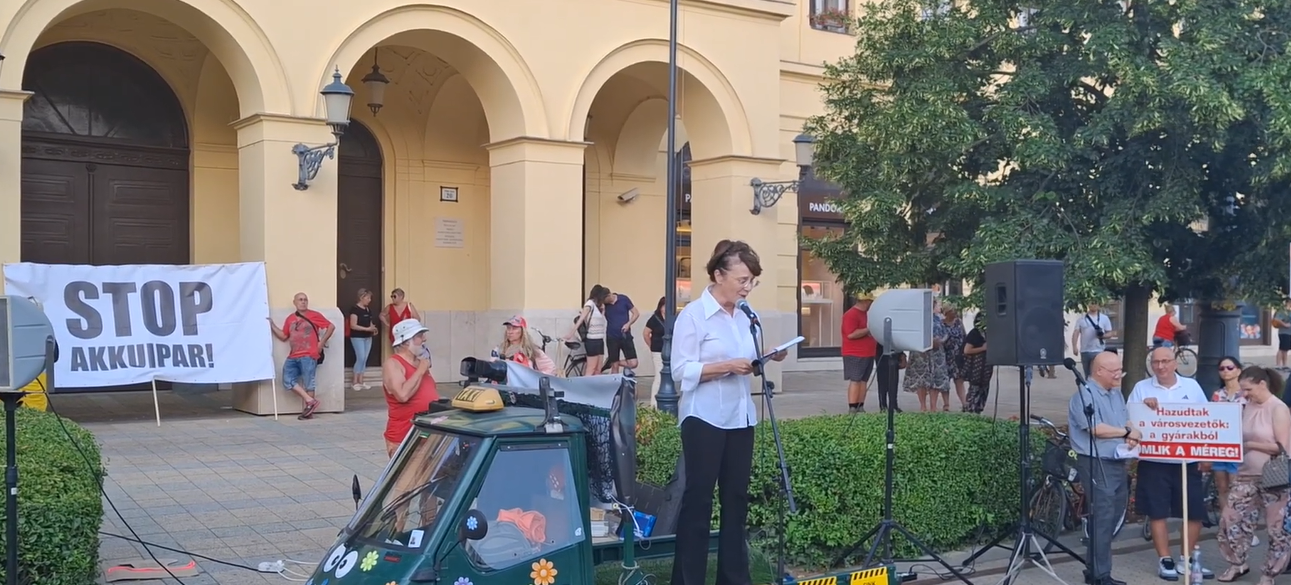
Around 1,500 people gathered in front of Debrecen’s Old City Hall on Friday evening to protest alleged environmental pollution linked to the city’s battery industry, what speakers described as political cover-ups surrounding the issue, and the authorities’ disregard for residents’ concerns. Throughout the demonstration, participants repeatedly called for the resignation of Mayor László Papp, expressing strong support for the speakers’ criticism of the city’s leadership.
The event was opened by Éva Fekete, representing the Nyíregyháza Green Action Group, who said battery industry investments now affect numerous Hungarian communities and that “the cup has overflowed.” She argued that residents of towns including Iváncsa, Göd, Komárom, and Fót face similar challenges.
The first speaker, Judit Veresné Péter, representing the Alliance for Justice for Battery Industry-Affected Communities (AKÁR) and the Szolnok-based campaign “No More Electrolyte Factories! Szolnok Wants to Live,” said that battery industry projects now affect more than 40 Hungarian municipalities, with nearly 50 battery-related facilities operating or under construction nationwide.
She urged the government to begin formal consultations with civil society organizations on national battery industry policy, noting that a package of proposals previously submitted by 40 environmental organizations had received no meaningful response.
A central demand of her speech was a comprehensive review of Hungary’s battery industry strategy. According to Veresné, projects of this scale should be evaluated through a nationwide strategic environmental assessment rather than on an individual basis. She argued that Hungary has become one of Europe’s leaders in battery manufacturing capacity relative to its population, despite repeated warnings from engineers, environmental experts, economists, and scientific bodies about the risks of excessive expansion.
The alliance is also calling for a moratorium on new battery industry investments until comprehensive environmental assessments have been completed, a review of already approved projects, stricter penalties for companies violating environmental regulations, and new legislation requiring hazardous industrial facilities to be located at a safe distance from residential areas.
Veresné also argued that local communities should have a genuine say in major industrial developments, proposing that future strategic projects should only proceed with meaningful public consultation and, where appropriate, local referendums.
She cited several examples—including cases in Maglód, Kistarcsa, Szigetszentmiklós, and Göd—where environmental groups believe authorities failed to adequately address permitting issues, environmental shortcomings, or excessive noise. She also called on national and local media to treat battery industry protests as an issue of nationwide importance, arguing that pollution and water consumption extend far beyond municipal boundaries.
The audience repeatedly chanted one of the protest’s main slogans: “Stop the battery industry! Now!”
Another speaker, a Debrecen resident who identified himself as a local activist, described what he said was a recent incident near the Semcorp factory. He claimed that while photographing emergency response activity from a public area during a night shift change, security guards confiscated his phone, viewed its contents, and deleted the recordings. He said he intends to pursue legal action and argued that the incident illustrates the need for greater transparency and independent oversight of industrial facilities.
He maintained that the public has a right to know what is happening inside the factories and said companies should have nothing to hide if they are fully complying with regulations.
Dr. László Kerekes, a surgeon and county assembly member, focused on the potential health risks associated with heavy metals and chemicals used in battery production, including nickel, lithium compounds, and N-methyl-2-pyrrolidone (NMP). He argued that these substances can contaminate air, soil, and groundwater, potentially causing long-term health problems, and called for stricter environmental monitoring and regular medical screening for nearby residents.
One of the evening’s most emotional moments came when Szilvia Fehér, an activist with the Mothers for the Environment of Mikepércs Association (MIAKÖ), read a letter from a family leaving the nearby village of Mikepércs. The family wrote that they were moving nearly 500 kilometres away because they no longer believed they could safely raise their children near the planned industrial developments. According to the letter, the move was not voluntary but driven by a loss of security and confidence in the future.
Retired Debrecen teacher Endre Asbóth, introduced as someone who had previously worked close to the city’s leadership, said he now openly opposes the battery industry developments. He called on demonstrators to demand Mayor László Papp’s resignation, noting that opposition councillors have already proposed dissolving the city assembly.
Asbóth contrasted Debrecen’s former industrial base—including clothing, food-processing, and tobacco factories—with today’s battery industry investments, arguing that earlier industries imposed far less environmental pressure. He criticized the city’s transformation into a major industrial centre without what he described as adequate public consultation and accused local leaders of failing to honestly inform residents about the potential consequences.
He also argued that battery manufacturing is highly demanding in terms of water, energy, and land use—resources he believes Hungary cannot afford to overuse. He criticized the industry’s reliance on foreign guest workers, claiming the new factories have not primarily created opportunities for Hungarian employees and calling for scrutiny of migrant workers’ living conditions.
In his closing remarks, Asbóth urged authorities to suspend and thoroughly investigate facilities linked to environmental concerns and called for the creation of a genuinely independent and robust environmental protection system.
The final speaker was Éva Kozma, representing MIAKÖ, who stressed that the protest was not directed against Hungary’s new government, arguing that the current administration has only recently taken office. However, she said many officials from the previous system remain in government offices and local authorities, meaning that, in her view, the same approach to environmental issues continues.
Kozma described Hungary’s water security as the country’s most pressing environmental challenge, arguing that battery factories consume large quantities of water while also posing risks to groundwater resources. She questioned whether the country’s drinking water reserves should be prioritised for industrial use.
She sharply criticized Debrecen’s municipal leadership, saying she found Mayor Papp’s recent expressions of concern unconvincing because, in her view, the city had actively supported battery industry investments from the outset.
Presenting MIAKÖ’s demands, Kozma called for repealing legislation that grants battery manufacturing strategic infrastructure status, arguing that this gives the industry preferential access to water resources during shortages. She insisted that the public’s drinking water supply must always take priority.
She also demanded immediate physical environmental remediation in Debrecen’s southern industrial zone, a comprehensive independent investigation into contamination, expanded testing of all groundwater monitoring wells by accredited laboratories, greater involvement of civil organizations in the investigations, official registration of confirmed contamination in land records, and the application of the “polluter pays” principle so that responsible companies—not taxpayers—bear the costs of environmental cleanup. She concluded by once again calling for the closure of polluting facilities and a comprehensive reform of Hungary’s environmental authorities.