








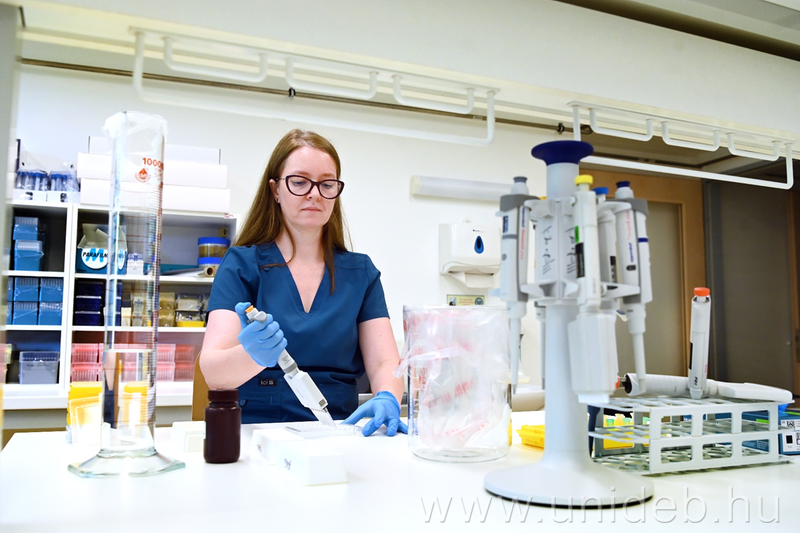
The research group of Eszter Csoma, assistant professor, received the Publication Award of the Count István Tisza Foundation for the University of Debrecen and the University of Debrecen for their scientific paper summarizing studies on polyomaviruses. Many questions remain unanswered regarding the newly identified polyomaviruses that infect both animals and humans. The researchers primarily examined whether these viruses are present in Hungary, at what age infection typically occurs, and whether they infect the respiratory tract.
Polyomaviruses derive their name (poly = many, oma = tumor) from the tumor-inducing ability of the first viruses described in rodents, which was already proven in the 1950s. In the 1970s, two human-pathogenic viruses (BK and JC polyomaviruses) were isolated. Today we know that these infect most people without causing significant symptoms, then establish latency, hiding in the body. Reactivation – renewed replication of the viruses – in immunosuppressed patients can cause severe, even life-threatening conditions. Diagnosing these two viruses is now routine in medical microbiology.
Since the 2000s, thanks to rapidly advancing sequencing technologies, eleven new human-pathogenic polyomaviruses that infect various animals and humans have been described. However, only two are confirmed to cause disease, one of which leads to a rare but very aggressive skin tumor. For the remaining nine viruses, almost all questions remain open. The Debrecen researchers examined two of these newly discovered polyomaviruses in detail.
“The MW and STL polyomaviruses, discovered in the 2010s, still have almost all basic questions unanswered. We focused on two areas in our research. With seroprevalence studies, we assessed whether these viruses occur in Hungary, what proportion of the population is infected, and at what age. Our other goal was to examine possible respiratory transmission: replication in the airways and associated lymphoid organs such as the tonsils, co-infecting viruses, and respiratory symptoms. Although the publication presents results on two viruses, in parallel we studied nine polyomaviruses,” explained Eszter Csoma, assistant professor at the Institute of Medical Microbiology, Faculty of Medicine, University of Debrecen.
In the seroprevalence studies, antibodies against the MW and STL polyomaviruses were detected in blood samples, proving whether individuals had been infected. The researchers themselves developed the appropriate serological method for this study and even produced the necessary viral antigens. They performed several thousand measurements on blood samples from people of different ages and analyzed the data. They also collected tonsil tissue from patients undergoing tonsillectomy, as well as throat and middle ear secretions, and respiratory samples taken during the SARS-CoV-2 pandemic. These were examined for the presence and sequence of the two polyomaviruses.
“We found that both viruses are present in Hungary. The proportion of those infected with MW polyomavirus increases with age up to young adulthood; more than half of the adult population is seropositive, meaning they carry antibodies against the virus. STL polyomavirus is more common: more than 80 percent of people are infected, most during early childhood. Our results suggest that these viruses may spread via respiratory secretions, replicate in the airways, and even reach the middle ear. We mainly detected both viruses in samples from children,” added the researcher.
Their results were published in an international scientific journal. The article received the Publication Award of the Count István Tisza Foundation for the University of Debrecen and the University of Debrecen.
“This recognition is an honor, and as a supervisor, a source of pride as well. My diligent, talented PhD students, at the start of their research careers, participated in a multi-threaded project and produced work of such quality that it achieved this outcome. The award is a positive reinforcement that gives momentum for the future. Four of us participated in the research: two PhD students, Melinda Katona and Krisztina Jeles, along with senior research fellow Péter Takács and myself. Melinda Katona is listed as the first author of the paper, and this study formed part of her doctoral research. Since the article’s publication, she has successfully defended her dissertation, for which this was one of the foundational works,” emphasized Eszter Csoma.
Although the Debrecen researchers’ studies provided significant new information compared to previously published results, the team continues their investigations. They are constantly collecting new samples to further study respiratory replication, co-infecting pathogens, associated symptoms, and possible seasonality. They are also examining the presence of the viruses in different sample types and their spread within the body. They seek to answer which cells allow replication and which may serve as target cells for the viruses. Their ultimate goal is to study viral replication in vitro, which is key to understanding the pathogenesis of these viruses.
(unideb.hu)