








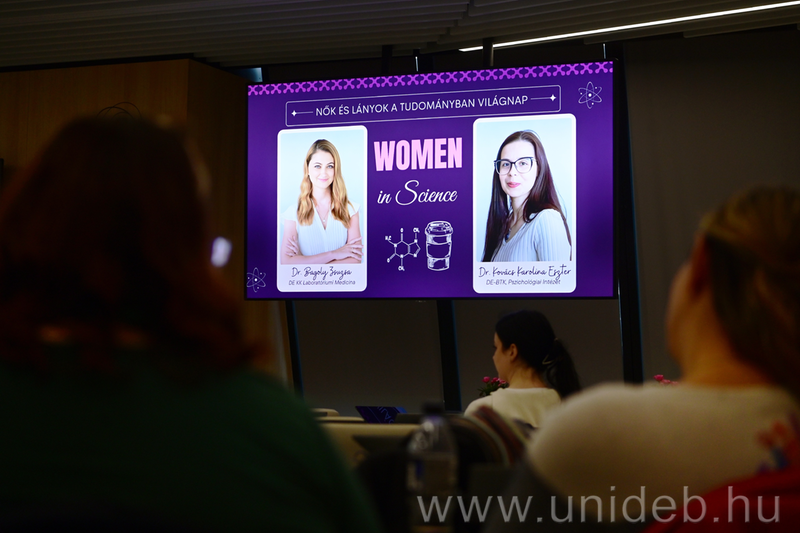
How can a woman be both a respected researcher and a mother? How can work–life balance be achieved? What challenges does a scientific career present, and how can they be overcome? These questions were addressed by two outstanding female researchers at the University of Debrecen during an event organized for the International Day of Women and Girls in Science.
For the third time, the Institute of Chemistry at the university’s Faculty of Science and Technology invited members of the academic community to a discussion aimed at highlighting the importance of equal opportunities in science through inspiring speakers.
“The main message is that science belongs to everyone. With this event, we want to emphasize inclusivity and ensure that higher education and scientific careers offer equal opportunities to all, regardless of family background, life path, or gender. Diversity in science is the driving force behind innovation—science belongs to everyone,” said organizer Edina Baranyai, assistant professor in the Department of Inorganic and Analytical Chemistry.
She added that science remains a male-dominated field worldwide. Although the University of Debrecen places strong emphasis on highlighting the role of women, it cannot be stressed often enough—especially to young girls—that knowledge and talent can open the door to an academic career for them as well.
One excellent example is Associate Professor Zsuzsa Bagoly of the Institute of Laboratory Medicine at the university’s Clinical Center, who shared her personal journey, emphasizing that dedication, continuous learning, and self-improvement ultimately pay off.
“In English, we call it ‘grit’—a combination of perseverance, diligence, and often sacrifice that leads to success in a scientific career or elsewhere. For women, however, periods of childbirth, returning to work, and balancing household responsibilities with building independent research groups and writing grant proposals can pose particular challenges. Those of us who are already in a position to do so should help smooth out these inequalities. Today, there are many groups and initiatives dedicated to this goal, such as the Young Academy of Researchers, where I serve as a board member,” Bagoly emphasized.
Karolina Eszter Kovács, assistant professor at the Institute of Psychology of the Faculty of Humanities and also a member of the Young Academy of Researchers, added that the organization strives for equality not only between genders.
“Men can also find themselves in situations where they stay at home with a child or take on a significant share of household and parenting responsibilities. In such cases, their interests must also be represented,” she noted.
Kovács mentioned that she recently saw archival footage of Marie Curie, the first female scientist to gain worldwide recognition, being honored by around two hundred men bowing before her in respect. While much progress has been made since then, she believes that awareness-raising is still needed in many areas—not only among men, but also among women toward other women—since competition remains intense.