







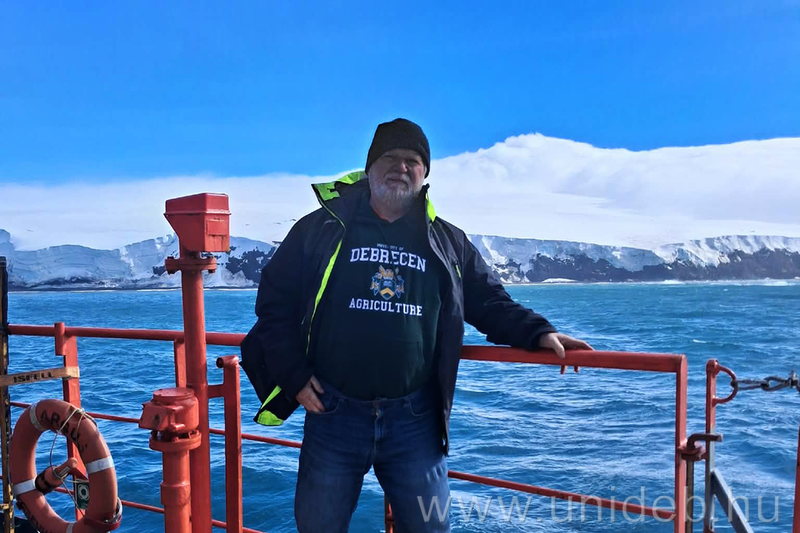
As the first Hungarian scientist to set foot on Bouvet Island, a Norwegian Antarctic territory, László Radócz from the University of Debrecen’s Faculty of Agriculture, Food Science, and Environmental Management joined a two-week international scientific expedition on the glacier-covered island, visited by fewer than 200 people—fewer than have been to space.
Bouvet Island (Norwegian: Bouvetøya) covers 58.5 km², over 90% of its surface is glaciated, and it has been under Norwegian sovereignty since 1927. Its extreme isolation makes it one of the ten least visited places in the world.
“I participated in a successful West Antarctic expedition on the South Orkney Islands in 2020. Following that project, I was invited again to a 14-member scientific team in February and March 2026 to study this Norwegian Antarctic island. During the short polar ‘summer,’ my tasks included studying the occurrence of endemic fungi and lichens, and managing satellite and shortwave communications,” Radócz told hirek.unideb.hu as the only Hungarian participant.
Bouvet Island is a designated Protected Marine Area, and entry requires special permits from the Norwegian Polar Institute along with strict adherence to regulations.
Radócz and the team met in Cape Town, South Africa, the nearest inhabited city, where the expedition containers with necessary equipment awaited. Following departure on February 21, the team endured a six-day voyage around the treacherous Cape of Good Hope aboard the icebreaker ARGUS. They spent 14 days on the uninhabited island in tents under extreme weather conditions, recalled the university associate professor from the Faculty of Agriculture’s Plant Protection Institute.
The group, consisting mostly of Norwegian, Icelandic, German, Italian, Faroe Islands, and Ukrainian researchers, and all equipment, were airlifted by helicopter to an ice-free high-altitude point on the island, where the wind blew almost constantly.
“The coastline is steep cliffs. Landing by boat is extremely difficult, dangerous, almost impossible. Weather windows suitable for flight are very short, usually 1-2 hours daily, and sometimes you have to wait days. Transporting the team and equipment ashore took three days, and loading them back onto the ship took another three. Perhaps that is why fewer than 200 people have ever visited this point on Earth—fewer than have been to space,” added Radócz.
Following the expedition, the researchers began analyzing and preserving the collected samples and processing the data.
(unideb.hu)