






For the first time, the Department of English Linguistics at the Institute of English and American Studies, Faculty of Humanities, University of Debrecen, is organizing an English-language international linguistics summer school called OVA 2026 (Omnes Voces Acceptamus 2026).
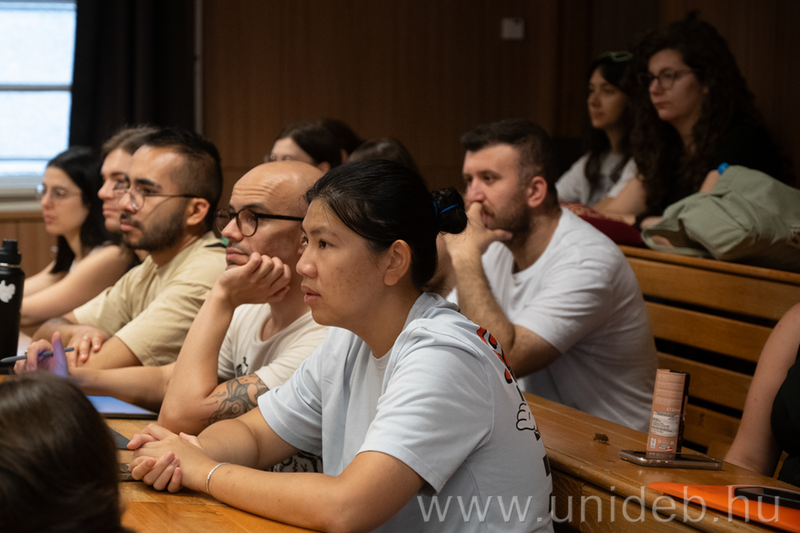
The event, held between July 27 and August 7, 2026, has brought nearly 100 students from almost ten countries to Debrecen to expand their knowledge of linguistics under the guidance of a distinguished international faculty.
OVA was established to make high-quality education in formal linguistics accessible to students from diverse geographical, academic, and economic backgrounds. The program offers introductory and advanced courses in syntax, semantics, phonology, and morphology, while also covering experimental methods, statistics, and the connections between different areas of linguistic structure. Participants also have the opportunity to present their ongoing research, develop practical research skills, and build professional relationships with both established scholars and early-career researchers. This combination of academic excellence, accessibility, and inclusiveness makes OVA a unique initiative.
A summer school that welcomes every voice
At the opening ceremony held on July 27 in the University’s Main Building, Magdalena Lohninger of the University of Salzburg, speaking on behalf of OVA, welcomed the students and faculty members. She noted that an enormous amount of work had gone into creating the new summer school over the past year and emphasized that it would not have been possible without the support of colleagues from around the world, the dedication of the local organizers, and the enthusiasm of the international linguistics community.
“OVA is a linguistics summer school that places equality, fairness, and diversity at its core,” Lohninger said. “This is reflected in the composition of our teaching staff, the diversity of theoretical approaches represented, and the Code of Conduct we have introduced. Together, these help ensure that every participant has the best possible academic and personal experience.”
The name OVA is an abbreviation of the Latin phrase Omnes Voces Acceptamus, meaning “We welcome every voice.”
Diversity strengthens science
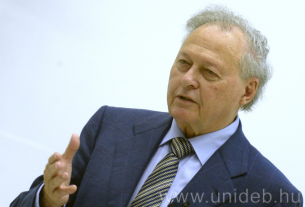
In his welcoming speech, Péter Csatár, Acting Vice Dean for Strategy and Economic Affairs at the Faculty of Humanities, said he could hardly imagine a more appropriate guiding principle for a linguistics summer school—or for academic life in general.
“Linguistics teaches us that human language is characterized both by underlying structures and remarkable diversity,” he said. “Similarly, scientific communities require shared standards of argumentation and evidence, while at the same time depending on diversity in languages, theoretical perspectives, methodologies, and intellectual traditions.”
Csatár highlighted that linguistics has a strong and highly diverse presence at the Faculty of Humanities, represented by several institutes and departments whose research spans multiple languages, different levels of linguistic structure, and a broad range of theoretical and methodological traditions.
“Our faculty’s intellectual diversity reflects the conviction that linguistic phenomena can rarely be understood from a single perspective,” he explained. “Formal modelling, corpus analysis, experimental methods, computational approaches, discourse analysis, and historical research should not be seen as competing scientific enterprises. On the contrary, each contributes to a deeper understanding of how language is structured, how it is used, and how it changes. A university best fulfils its academic mission when different approaches can meet, challenge, and enrich one another.”
Students and lecturers from across Europe
The international character of OVA is reflected in both its participants and its teaching staff. Undergraduate, master’s, and doctoral students have arrived from countries including Bulgaria, Germany, Italy, and Türkiye, while lecturers represent prestigious universities such as the University of Göttingen, the University of Potsdam, and University College London.
The two-week program offers a broad range of courses covering syntax, semantics, and phonology, from introductory classes to advanced research-oriented seminars, ensuring that participants with different academic backgrounds can find courses suited to their level.
Beyond the classroom
One of the summer school’s key objectives is to minimize the distance between students and lecturers. To support this, all participants are accommodated in the same university residence hall, allowing students, faculty, and organizers to spend time together outside formal classes.
“This relaxed and friendly atmosphere creates an open, inspiring environment where students and lecturers alike can engage with linguistics,” Péter Szűcs, assistant professor at the Department of English Linguistics and one of the organizers, told hirek.unideb.hu.
In addition to lectures and seminars, the organizers have also arranged opportunities for participants to explore Debrecen, become familiar with the University of Debrecen, and experience Hungarian culture and gastronomy.
The full program of the OVA 2026 Linguistics Summer School is available on the event’s official website.