







At the symposium organized by the One Health Institute of the Faculty of Health Sciences and the Faculty of Agricultural and Food Sciences and Environmental Management of the University of Debrecen, PhD students from the university presented their latest research results under the framework of the “One Health” principle. The scientific meeting focused on the diversity of pathogens that pose risks to human health and the prevention of the diseases they cause.
The essence of the One Health concept is that human health cannot be separated from the state of animals and the environment — together, they form a single system when it comes to the spread and evolution of pathogens, as well as non-living harmful factors.
At Monday’s conference held in the Learning Center, PhD students from the Pál Juhász-Nagy Doctoral School, the Doctoral School of Animal Science, the Doctoral School of Food Science, and the Doctoral School of Pharmaceutical Sciences gave scientific presentations drawing attention to the dangers posed by various pathogens and the possible solutions and preventive measures. The aim of the symposium was to provide useful insights on the One Health principle not only for university students but also for staff and visiting high school students.



Gábor Kardos, head of the One Health Institute at the Faculty of Health Sciences, said at the opening that the international One Health Day is commemorated worldwide, emphasizing how this new principle and approach helps us better understand the interconnections among human, animal, and environmental health.
“Human healthcare, veterinary health, and environmental health are inseparable. This is an important and interesting approach not only in relation to diseases but also in terms of well-being. Everyone enjoys walking among the beautiful autumn leaves — in a broader sense, that too relates to health. Practically every faculty at the University of Debrecen contributes to implementing the One Health principle. Each has its own role and point of connection, even if the topic is most easily approached from the perspectives of health sciences, medicine, veterinary and plant health, or environmental health. This is why we organized this day in cooperation with several university units,” said the institute director.
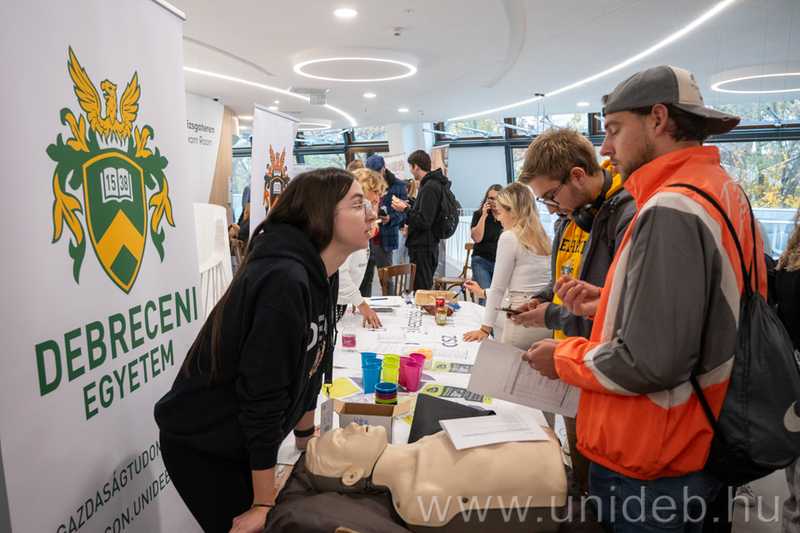
Alongside the scientific symposium held for One Health Day, the Learning Center also hosted informational booths for students and high school visitors. Volunteers from the University of Debrecen provided detailed information about the mission, achievements, and health challenges related to the One Health concept.
Visitors could attend lectures on topics such as invasive species and future diseases, the environmental effects of seed dispersal by waterfowl, immune stimulants based on edible mushrooms, the role of nano-selenium functional feed additives, and emerging or neglected zoonotic pathogens.
The program will take place between November 3 and 5 across all training locations of the University of Debrecen’s Faculty of Health Sciences — in Debrecen, Nyíregyháza, Szolnok, and Siófok.
(unideb.hu)