








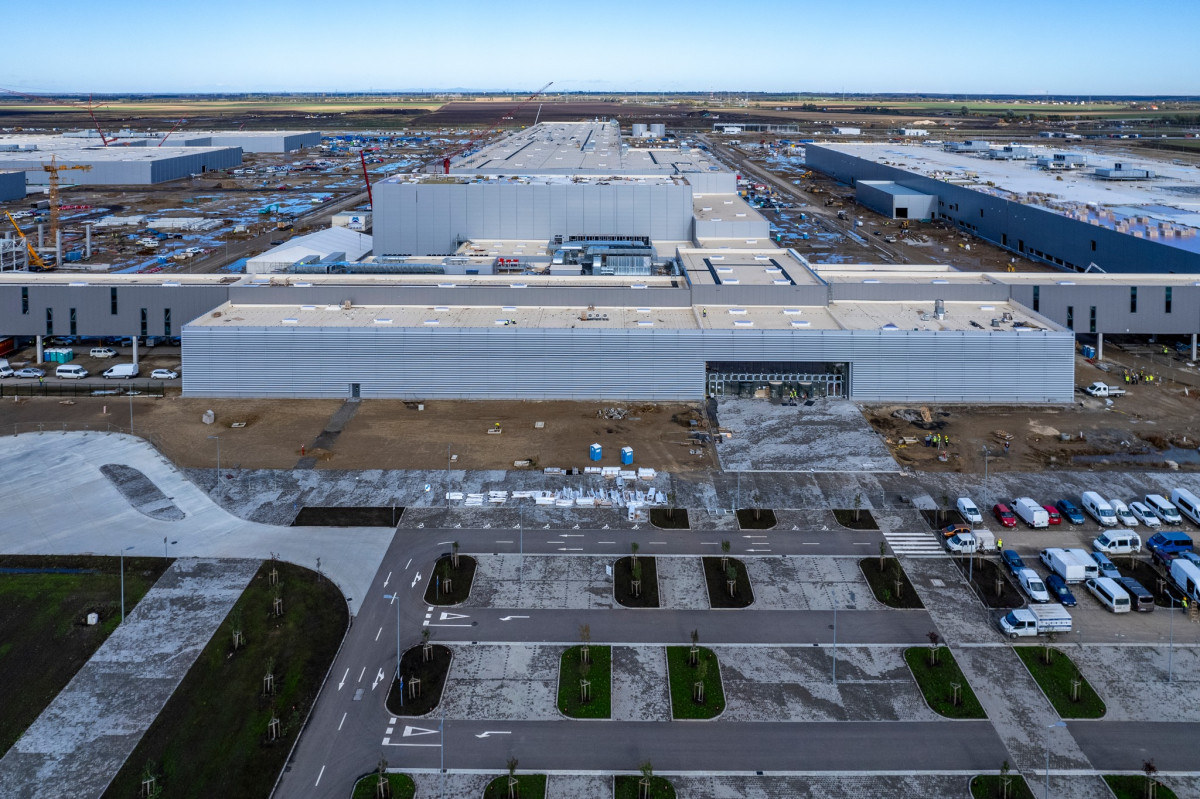
Debrecen wakes up to a big day on September 26: the BMW plant, a source of pride for the city’s political “elite,” is officially inaugurated. Let’s see how we got here.
The story of the BMW plant in Debrecen began on July 31, 2018, when Péter Szijjártó, Minister of Foreign Affairs and Trade, announced that the German automotive giant would build a new factory in Debrecen with an investment of nearly one billion euros. The aim of the plant was to produce about 150,000 vehicles annually and create over a thousand new jobs in the region. The decision was of great significance for both the Hungarian automotive industry and the economic development of the region.
Preparatory construction works accelerated in 2022, and on June 1 the ceremonial laying of the foundation stone took place. After the development of infrastructure, utilities, and roads, the structural works of various production units – including the body shop, paint shop, and assembly plant – also began between 2022 and 2023. In mid-2023, BMW signed a strategic cooperation agreement with the University of Debrecen to ensure that suitably trained professionals from the region would meet the plant’s future workforce needs. By the end of the year, the training center had been completed, the thousandth employee was hired, and the paint shop reached its highest structural point.
In 2024, the installation of production lines and logistics systems took place, and the plant began manufacturing pre-series vehicles, which BMW uses to test production and quality assurance processes under real-world conditions. A key feature of the Debrecen plant is that it will produce only electric vehicles: BMW’s new-generation “Neue Klasse” models, starting with the next generation of the iX3. The plant employs the most modern production technologies, including time-windowed deliveries, modularized assembly solutions, and simplified wiring harnesses, all of which enable efficient and flexible production. The logistics system is also innovative: thanks to its “comb” layout, parts are delivered directly to the assembly line.
The BMW plant in Debrecen will be one of the first facilities in the world to operate entirely without fossil energy sources under normal production conditions, thereby contributing to the company’s sustainability goals. Although there were recent reports suggesting that only two models, instead of the originally planned three, would be produced initially in Debrecen, BMW has officially denied that the project would undergo any substantial reduction. The company confirmed that reaching the maximum annual production capacity of 150,000 vehicles remains the target, with production expected to ramp up gradually.