






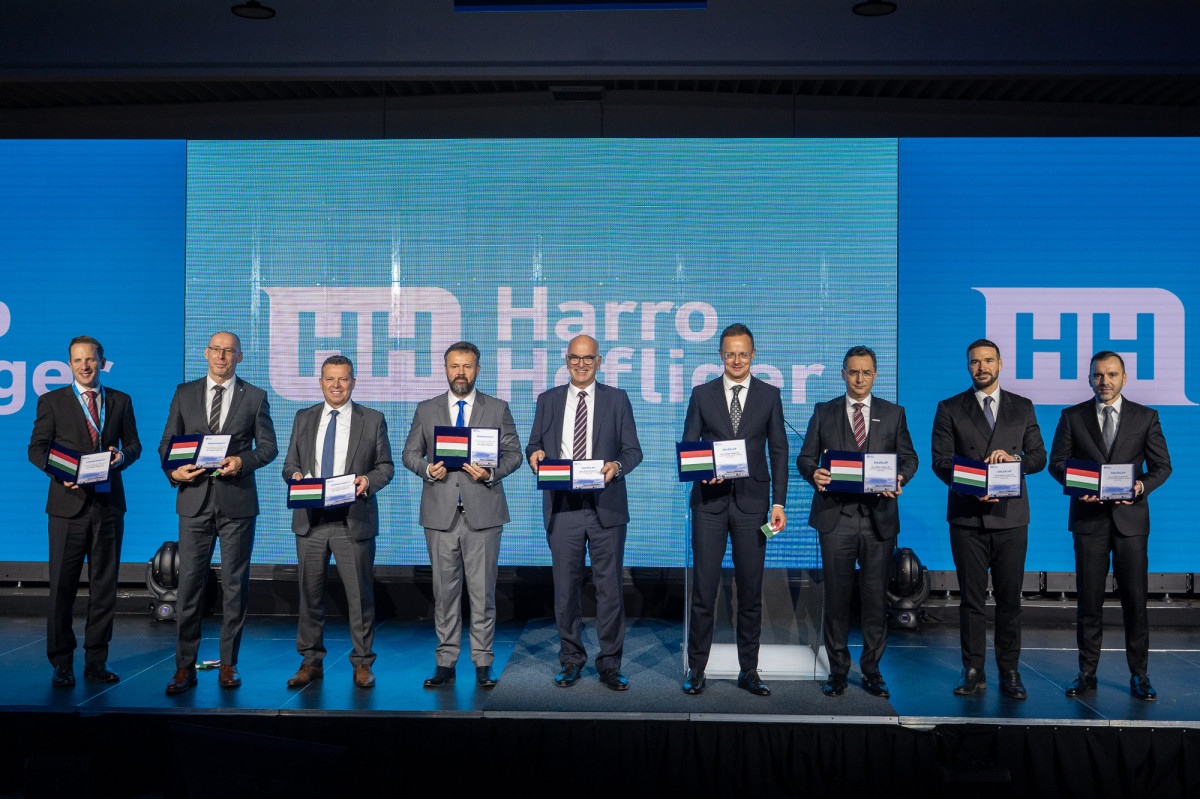
Harro Höfliger, a German company specializing in pharmaceutical machinery, has established its second-largest site outside Germany in Debrecen. The HUF 6 billion investment is expected to create over 100 new jobs in the city, announced Péter Szijjártó, Hungary’s Minister of Foreign Affairs and Trade, at the site on Friday.
Speaking at the inauguration of the new Harro Höfliger facility, the minister highlighted that the German machinery manufacturer invested HUF 6 billion in capacity expansion in Debrecen, with the state providing HUF 1.5 billion in support, helping to create more than 100 new jobs.
Szijjártó emphasized that the company is bringing its high-tech pharmaceutical machinery production to Hungary and that this plant will be its second-largest site outside Germany.
“Harro Höfliger’s expertise and high technological standards contribute to the flawless production of delicate and critically important healthcare devices, such as inhalers, insulin pens, and adhesive bandages,” he said.
He added that the company will launch a major supplier development program, allowing local small and medium-sized enterprises to benefit from the investment. Furthermore, Harro Höfliger will closely cooperate with the University of Debrecen and the Debrecen Vocational Training Center in educating young professionals.
The minister stressed that Hungary began a new economic era 15 years ago, when the government initiated the country’s reindustrialization, laying a solid foundation for the economy.
“With Europe’s lowest taxes, we have created the continent’s most successful and attractive investment environment, breaking records in investment inflows to Hungary year after year,” he said.
“We reorganized higher education and vocational training, learned from the best, and introduced German-style dual training programs. As more companies arrived in Hungary, more factories were built, more employees were needed—and we managed it,” he added.
Over the past 15 years, one million new jobs have been created, doubling the country’s industrial output despite global challenges that could have hindered economic and industrial performance.
“Industrial production has doubled over fifteen years, resulting in a threefold increase in average wages and a fourfold rise in the minimum wage,” Szijjártó noted.
He also highlighted that the strength of Hungary’s economy is reflected in the balance between domestic and foreign-owned companies.
“Foreign-owned companies bring the most modern technology to Hungary, creating tens of thousands of new jobs and allowing Hungarian businesses to enter modern global value chains,” he said.
Szijjártó underlined that Germany remains Hungary’s top economic, trade, and investment partner. Bilateral trade has reached €70 billion annually, with German investments totaling €37 billion. Over the past decade, the Hungarian government supported 324 large German corporate investments with HUF 400 billion, resulting in HUF 3,800 billion in investments.
The minister also pointed out that this investment demonstrates Debrecen’s economic diversity, showing that the city’s industry is not only about automotive or electronics but also includes modern pharmaceutical machinery production.
He stressed that while there were previously significant regional disparities between eastern and western Hungary, these have largely been eliminated, making Debrecen an important regional industrial hub.
“Over the past 11 years, the government has supported 131 major investments in Hajdú-Bihar county with over HUF 600 billion, resulting in HUF 4,000 billion in investments. Industrial output in the county has increased two and a half times over ten years, while unemployment has been reduced to less than half,” he concluded.