






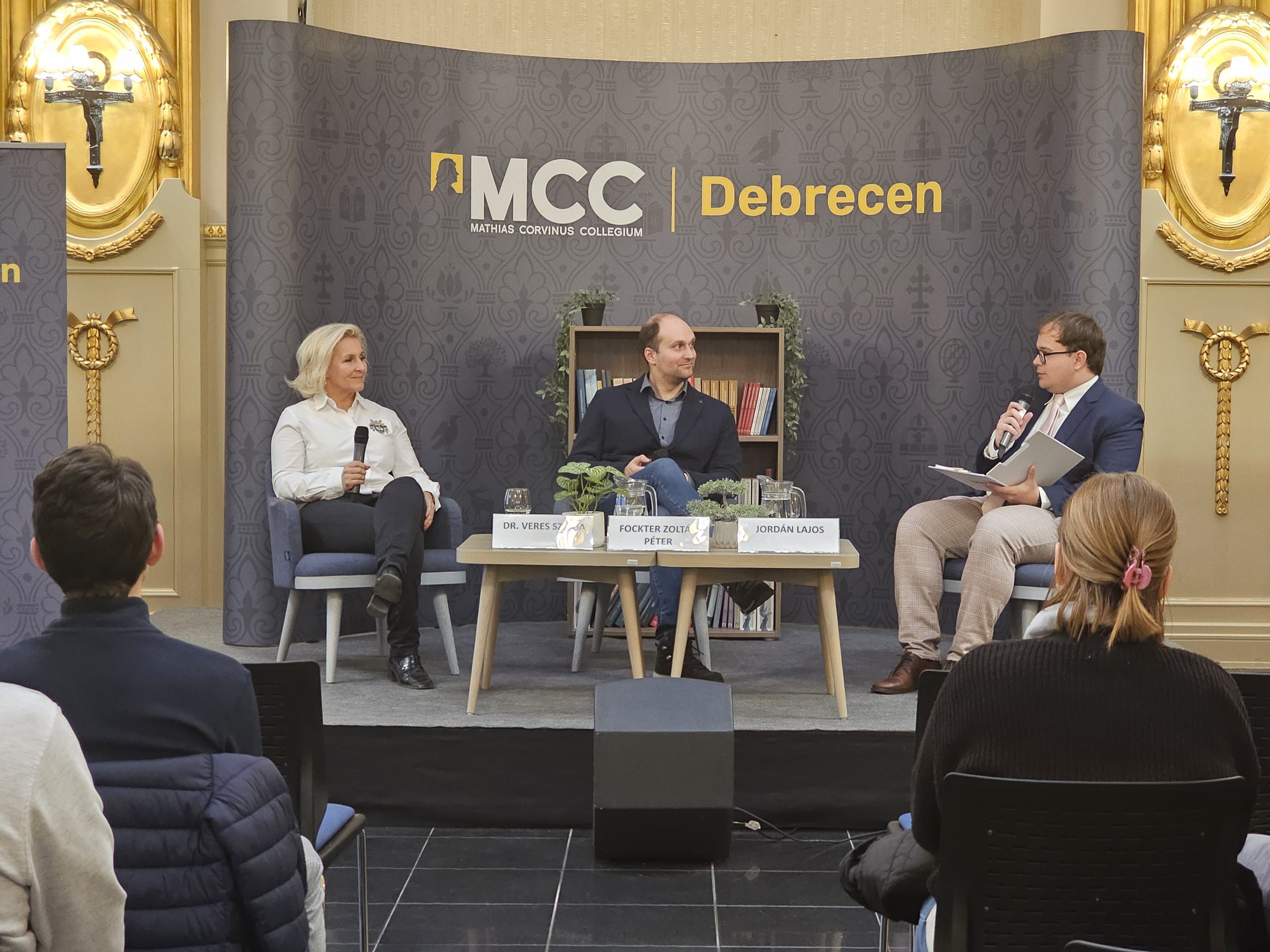
On March 6, 2026, the MCC Debrecen Training Center hosted the CORVUS Exhibition and a special lecture highlighting the present and future of Hungarian space research. The event attracted students, space enthusiasts, and the general public, offering a unique glimpse into the fascinating worlds of astronomy and space exploration.
The CORVUS Exhibition showcased the history of the first space stations, the workings of the International Space Station (ISS), and key milestones in Hungarian space achievements, from Bertalan Farkas to the HUNOR program. A centerpiece of the exhibition was the MCC CORVUS project, which featured six experiments conducted in space by researcher-astronaut Tibor Kapu in collaboration with astronomers and students from the MCC Young Talent Program.
After the opening, visitors toured the exhibition under the guidance of astronomer Zoltán Fockter, who offered expert insights into the projects and experiments on display. The program concluded with a lecture titled “Hungarians in Space – What We Learn Up There and How We Use It Down Here?”, in which two leading researchers shared their experiences in microgravity and explained the unique challenges of conducting experiments in space.
During the lecture, participants learned how the Corvus project produced educational materials from space, sent a thousand seeds to the ISS, and gathered scientific insights by studying how humans and plants adapt to environments that challenge all Earth-based assumptions.