






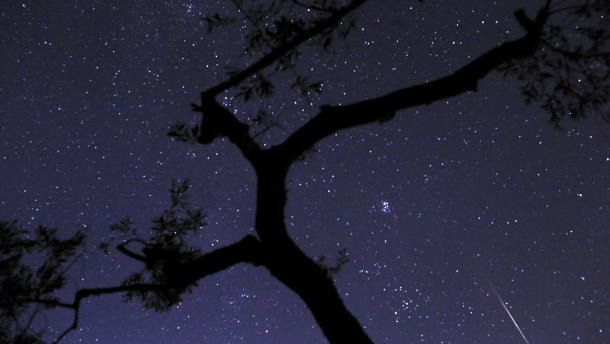
In the first days of January, the Quadrantid meteor shower will arrive, and a spectacular quadruple conjunction will also be visible in the night sky.
According to the announcement, the Quadrantid meteor shower will peak on the night of January 3. While the meteor shower usually produces a striking display of shooting stars, the brightness of the full moon may overshadow the fainter ones this time, so around 10–20 meteors per hour are expected to be visible in the northern sky.
However, the shower is rich in bright fireballs, which will still provide a beautiful sight even with the moonlight. Most meteors will be visible around midnight or in the early morning hours. A detailed article about the astronomical phenomenon and how to observe it is available on the Svábhegy Observatory blog: link.
In addition to the meteor shower, a spectacular quadruple conjunction can be observed on Saturday: at 6 p.m., below the full moon, the planet Jupiter will appear, and to its left, the two stars of the Gemini constellation, Castor and Pollux, will form a regular celestial parallelogram. Jupiter will appear as a very bright star under the Moon, while Pollux and Castor will be much fainter in the moonlight, according to the Svábhegy Observatory announcement.
(MTI)
Picture: illustration.