








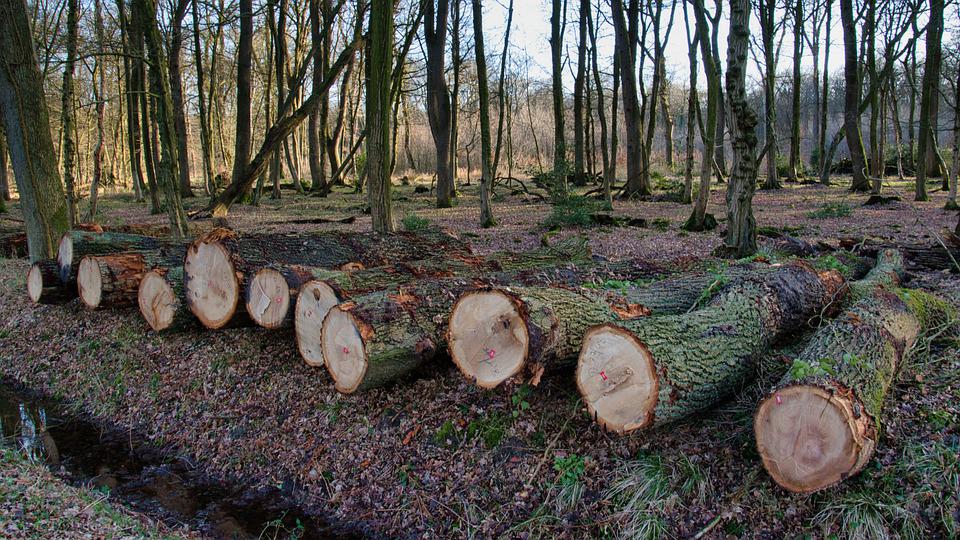
Protected forest habitats are disappearing in Hungary, while a large portion of the wood that is cut down and burned in power plants does not actually heat homes but instead contributes to global warming as waste. Several civil organizations drew attention to the flaws in Hungary’s poorly functioning logging and wood-use system on February 4 in the Bükk National Park, in Lillafüred.
In Hungary, about 95% of forest areas are used for timber production, including protected and Natura 2000 sites. The approach that primarily treats forests as sources of timber has the greatest losers in national parks, where preserving biodiversity should theoretically be the top priority.
Logging Areas in National Parks
Despite nearly fifty years of existence, significant portions of the Bükk National Park are still regularly subjected to logging. It is not uncommon for 140–150-year-old oak and beech forests to fall victim to timber extraction—forests that serve as irreplaceable habitats for numerous protected and strictly protected species.
These forests are home to species such as the white-backed woodpecker, the imperial eagle, the Eurasian eagle-owl, lynx, and the alpine longhorn beetle. They also play a key role in mitigating the effects of climate change. Mature, closed-canopy forests cool their surroundings, retain water, and reduce extreme weather impacts—functions that cannot be replaced by young plantations.
Most of the Cut Wood Becomes Smoke
More than half of the harvested timber is not used for durable purposes. Out of every hundred trees cut down, 62 are burned, with 20 of those ending up in biomass power plants. This amounts to about 1.4 million cubic meters of firewood each year—enough to fill nearly four Puskás Arenas with logs.
Around 60% of this firewood comes from Hungary’s native forests. This is particularly problematic because biomass power plants cover only 2.7% of Hungary’s electricity consumption. A balanced mix of solar and wind energy could replace this amount of energy with 41 properly placed wind turbines and 570 MW of new solar capacity—an increase of just 7% over Hungary’s current solar power capacity.
A Systemic Problem, Not Isolated Decisions
The situation is not the result of a few bad decisions but of a forestry and wood-use system that has long prioritized timber production over ecological considerations. While forest management typically follows current legislation, the existing rules cannot guarantee the protection of the most valuable forests. In planning and consultation processes, conservation interests often lose out to economic considerations—even within national parks.
“Legal” Interventions Are Not Always Nature-Friendly
Conservation efforts often achieve only minor changes in logging plans, while the structure, biodiversity, and ecological functions of forests are damaged. Thus, an intervention can be legally “correct” yet still work against natural regeneration. To change this, clear state and legal decisions are needed: in national parks and strictly protected areas, the sole purpose should be nature conservation, not timber production.
Civil Organizations Take a Stand
On February 4 in Lillafüred, the Association of Forest Lovers, Greenpeace Hungary, the Hungarian Ornithological and Nature Conservation Society, the Hungarian Nature Conservation Association, and WWF Hungary spoke out together in defense of protected forests.
Their position is that if we cut only as much wood as is currently used in biomass power plants, logging volumes could decrease by one-fifth. This would allow the most valuable forests—especially old-growth stands in national parks—to remain largely undisturbed habitats.
Alternatives Exist—Knowledge Is Available
Sustainable forest management methods already exist in Hungary that both protect habitats and provide a long-term supply of timber. A shift in approach is therefore not theoretical: the professional knowledge and experience are already in place. The question is which considerations will dominate decision-making.
Forests Are Not Fuel
Forests are complex ecological systems: they cool the environment, retain water, provide shade, reduce wind, and moderate climate extremes. The larger and more contiguous a forest, the stronger these effects.
Fragmenting and destroying forests is not only a conservation loss but a matter that affects the quality of life for everyone. According to these organizations, it is time to adopt a forestry approach that treats forests not as fuel, but as living ecosystems.ű
Bea Szöőr’s article in Hungarin can be found here.