




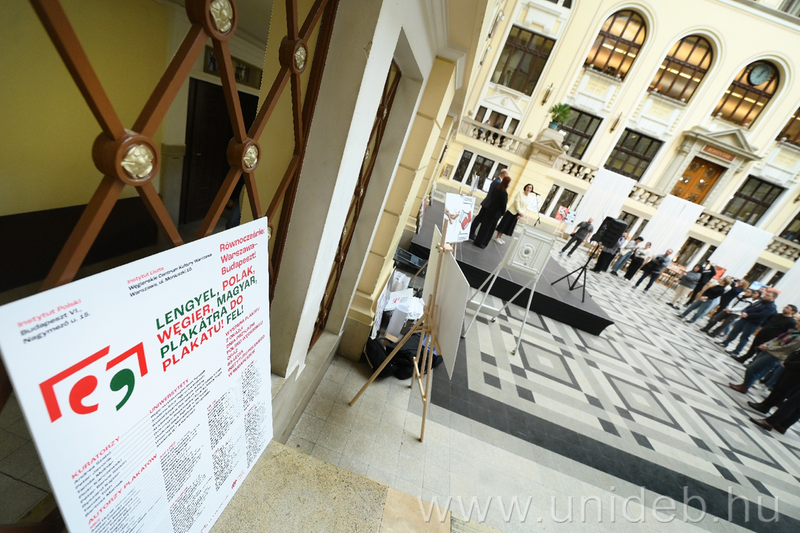
As part of an all-day event, visitors had the chance to explore Poland — its history, culture, traditions, gastronomy, and opportunities for study, scholarships, and employment. The event was organized by the Institute of Slavic Studies at the Faculty of Humanities of the University of Debrecen (UD), in cooperation with the Polish Institute in Budapest and the Polish Tourism Organisation. Held on April 2, the event marked the Polish-Hungarian Friendship Day.
The teaching of Polish language and literature in Debrecen has a history stretching back half a century. The program began in 1974 at the predecessor institution, the Institute of Slavic Philology of Kossuth Lajos University.
Since 2018, Polish has been offered as a minor program. Currently, 12 students are studying the language intensively — eight hours a week — while also gaining insight into Polish literature, history, and culture. Additionally, another 10 students are learning Polish either as a compulsory second Slavic language in the Russian track of the BA/MA in Slavic Studies, or as an elective, according to Éva Fórián, language instructor at the Institute of Slavic Studies.
The organizer added that the curriculum continues to expand — since 2023, Polish is also available to students of the Translation and Interpreting MA program.
“Poland is a fascinating blend of tradition and modernity: it boasts a proud historical heritage, a vibrant cultural scene, and a rapidly developing economy. Polish Day — organized now for the third time since 2018 by the Institute — is a great opportunity to bring Poland and the Polish language closer to everyone. Learning a language is always a key to understanding culture and traditions more deeply,” said Jarosław Bajaczyk during the opening ceremony held in the Main Building’s Courtyard.
The director of the Polish Institute in Budapest emphasized that Poland offers excellent opportunities for students from around the world — including those studying at the University of Debrecen.
On behalf of the Polish Tourism Organisation, co-organizer Melinda Farkas — head of the Budapest office and former Russian-Polish studies student and later lecturer at UD — welcomed the participants. She stressed that her current career, promoting Poland to a broad audience, wouldn’t have been possible without her studies in Debrecen.
The day’s programs were all designed to inspire curiosity about Poland: an exhibition of illustrations by Marianna Oklejak was hosted at the Kölcsey Ferenc Reformed Primary School; in the university’s Main Building Courtyard, posters designed by Polish and Hungarian art students were on display. Blogger Tibor Csanádi “Ulu” gave a talk about Polish pub culture, Polish cities were introduced, and visitors could join an entertaining quiz game about Poland — with tastings included. The day concluded with a film screening at the Apolló Cinema.
(unideb.hu)