







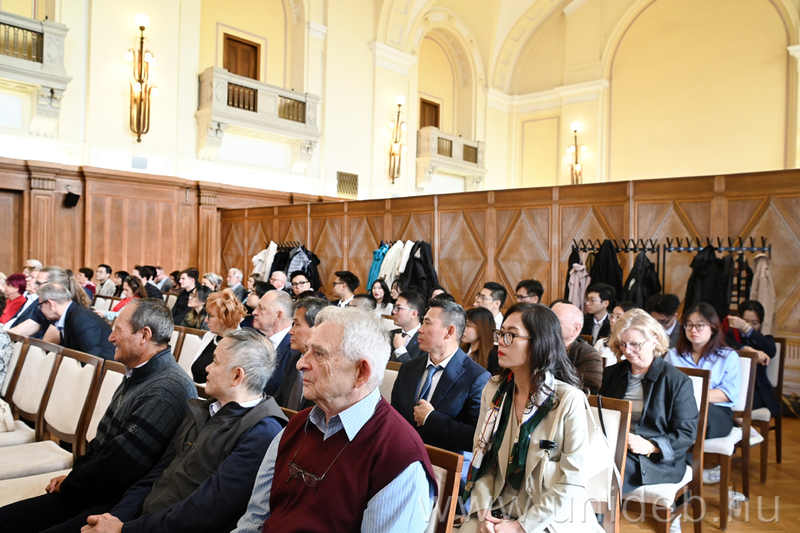
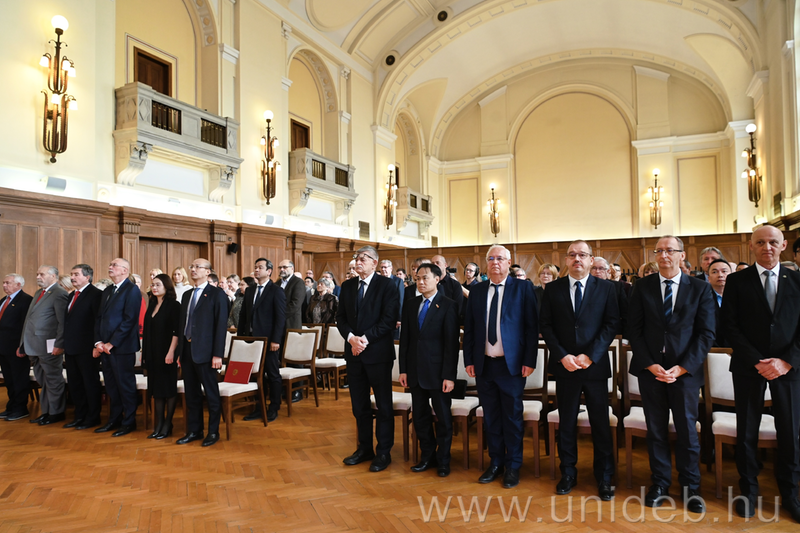
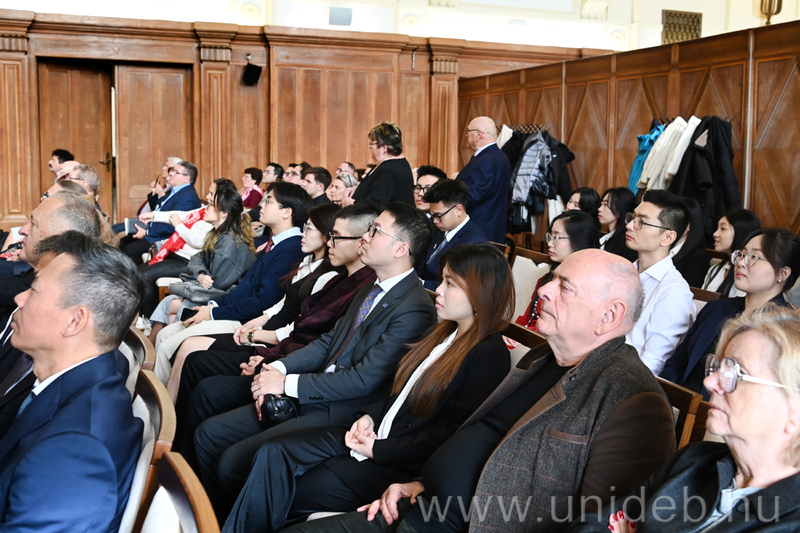
The number of Vietnamese students at the University of Debrecen has increased significantly over the past two decades, with most coming to study medicine. This was one of the highlights of the ceremony held on Thursday at the University of Debrecen to mark the 75th anniversary of the establishment of diplomatic relations between Hungary and Vietnam.
The joint event was organized by the University of Debrecen (UD), the Hungarian–Vietnamese Friendship Society, the Embassy of Vietnam, and the Kossuth Lajos University Circle. Rector Zoltán Szilvássy recalled that when he was a student, he had many Vietnamese classmates with whom he shared good friendships.
“The most important bond of Hungarian–Vietnamese friendship — human relationships — was woven in Hungarian universities. Today, our higher education institutions continue to find strong Vietnamese partners,” said Szilvássy.
He emphasized that while the University of Debrecen has long maintained a broad network of successful Western partnerships, in recent years it has also focused on strengthening cooperation with Eastern countries, recognizing that linking Eastern and Western cultures offers enormous potential. Vietnam, he said, could be an important partner in this process. He also recalled that UD was the first Hungarian university to join the Belt and Road Initiative, whose university research network will hold its annual presidential roundtable next year in Debrecen. Vietnamese partners have been invited to the event.
Elek Bartha, Vice-Rector for Education, noted that around fifty years ago, after the Vietnam War ended, the still-fragmented higher education landscape of Debrecen suddenly saw an influx of Vietnamese students, many of whom studied in the natural sciences or medicine.
“During those university years, lifelong friendships — and even romances — were formed between Hungarians and Vietnamese. The families that came into being at that time remain important pillars of our institutional relations today. Mutual sympathy and respect continue to characterize the two nations,” said Bartha.
Bui Le Thai, Ambassador of Vietnam to Hungary, reminded attendees that Hungary was among the first European countries to recognize Vietnam’s independence in 1950.
“The Vietnamese people greatly appreciate and remember the help Hungary provided during the struggle for national reunification and the rebuilding period that followed. Since then, our countries’ relations have advanced considerably,” the Ambassador said.
He also highlighted that thousands of Vietnamese citizens have studied — and continue to study — in Hungary, including at the University of Debrecen. He expressed hope for future joint higher education research projects and suggested that Debrecen could serve as a gateway for Vietnamese products — such as agricultural, woodworking, and fishery goods — to enter the Hungarian and regional markets.
In a video message, László Papp, Mayor of Debrecen, emphasized the growing interest of foreigners, including Vietnamese nationals, in the city in recent years. He mentioned ambassadorial visits, conferences, and exhibitions focused on Vietnam. Vietnamese youth regularly participate in Hungarian language programs organized by the Debrecen Summer University, and some even pursue vocational training in the city.
“More and more Debrecen residents now have the chance to visit Vietnam, and all of them return with admiration for the country’s natural wonders and the warm hospitality of its people,” said Papp.
Zoltán Pajna, President of the Hajdú-Bihar County Assembly, recalled that when he was in high school in 1974, his school participated in the Debrecen Flower Carnival with a float modeled after a Vietnamese teahouse.
“Our county’s outstanding geothermal resources have already attracted interest from Vietnamese partners, and this could open opportunities in health tourism, spa development, or agricultural use of thermal waters,” he said.
Márton Váraljai, retired Hungarian ambassador to Vietnam and vice-president of the Hungarian–Vietnamese Friendship Society, gave an overview of Vietnam’s modern history and its struggle for independence. He recounted how the country became a French colony in 1884, was occupied by Japan during World War II, then fought the First Indochina War (1946–1954) under Ho Chi Minh’s leadership, defeating the French. The subsequent war against the Americans lasted until 1975. Hungary contributed to Vietnam’s post-war reconstruction, and the country has since undergone remarkable development.
László Botz, retired lieutenant general and president of the Hungarian–Vietnamese Friendship Society, recalled that in 1973, Hungary sent 524 soldiers and law enforcement officers, along with 112 diplomats and civilians, to Vietnam as part of the International Commission of Control and Supervision, which monitored the ceasefire. Two Hungarian participants lost their lives during the mission.
Ferenc Kun, Dean of the Faculty of Science and Technology, reported that the faculty currently has about 2,500 students, of whom nearly 800 are international, including 17 Vietnamese.
Between 1970 and 1992, the majority of the faculty’s foreign graduates were Vietnamese — 56 in total — who even learned Hungarian for a year before starting their university studies, since no English-language programs existed at that time.
“During that period, Vietnamese students studied in nine different majors at our faculty, with the most popular being mathematics (20 graduates) and physics (16 graduates),” Kun said.
Attila Jenei, Director of the International Education Coordination Center, who has visited Vietnam more than thirty times, said that promotional events introducing the University of Debrecen are regularly held in Vietnam and enjoy great success. Since 2004, 470 Vietnamese students have chosen to study in Debrecen, most of them in medical programs.
At the end of the celebration, participants enjoyed samples of Vietnamese food, agricultural, and handicraft products provided by the Vietnamese Embassy, and watched “The Flower of the Apple Tree”, a Hungarian–Vietnamese co-produced feature film.
(unideb.hu)