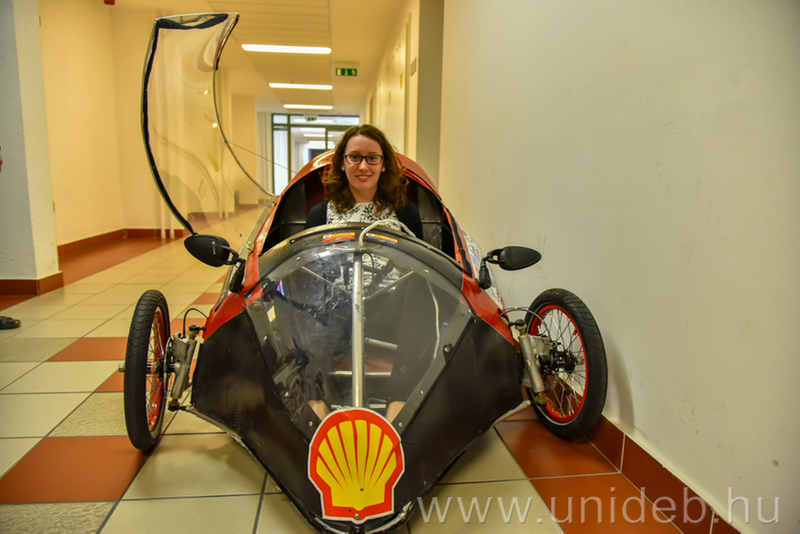








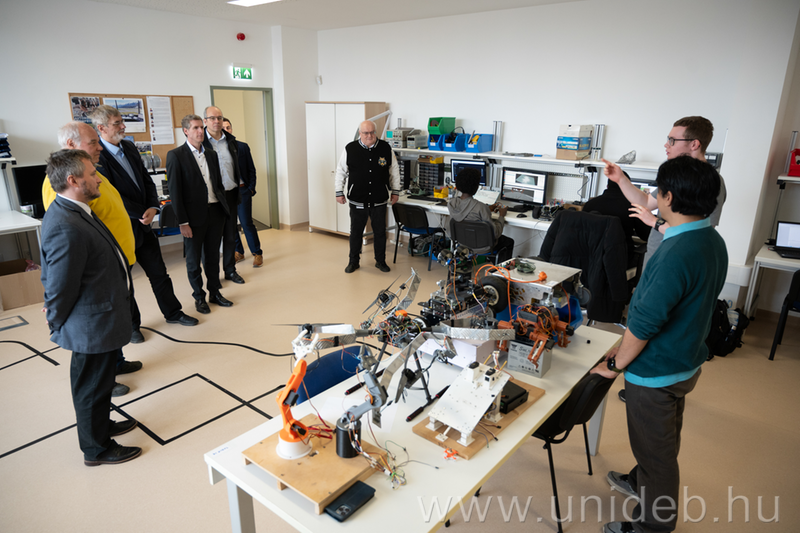
Hungary now produces 70 percent of its industrial output using high-tech solutions, enabling the manufacturing of world-class cars, electronic components, mechanical systems, and batteries. In the near future, the country will also be able to participate in humanoid robot production, supported by the knowledge base at the University of Debrecen (UD), as highlighted during a workshop by UD’s Autonomous Machines Working Group on Wednesday.
Following artificial intelligence, the next level of technological development is expected to be the widespread use of humanoid, or human-like, robots. Some experts predict that by 2040 there could be 10 billion humanoid robots performing many tasks currently done by humans, said László Palkovics, head of UD’s Institute for Automotive and Artificial Intelligence Coordination, at the workshop hosted by the Faculty of Engineering.
The UD Autonomous Machines Working Group brings together experts in technical sciences at the university, focusing on the development of autonomous vehicles, robots, and other intelligent machines.
Palkovics, who also holds a degree in mechanical engineering, emphasized that the government aims for Hungary to become a key player in humanoid robotics, and multiple steps have been taken to achieve this.
-
“Seventy percent of Hungary’s industrial output is now based on high-tech solutions. World-class cars, electronic components, mechanical systems, and batteries are produced here. Artificial intelligence provides another opportunity to advance, enabling data-driven solutions that improve our world,” Palkovics said.
He highlighted that domestic research institutions possess world-class knowledge in autonomous vehicles.
-
“For example, Bosch employs around 4,000 development engineers in Hungary, primarily working on autonomous technologies. Similar work is being done at Knorr-Bremse, Thyssenkrupp, and Continental. Hungarian research in autonomous vehicles is on par with the best in the world,” he said.
Palkovics added that the University of Debrecen is deliberately increasing its capacity and capabilities in this field, and Debrecen hosts industrial facilities that play a crucial role in this ecosystem.
The workshop also featured presentations by Péter Gáspár, head of the System and Control Theory Laboratory at the HUN-REN SZTAKI Research Institute of Computer Science and Automation, discussing results from the National Laboratory of Autonomous Systems; István Szászi, head of Bosch Hungary and the Adriatic region and managing director of Robert Bosch Ltd., who defined why and how UD should engage in this field; and Ákos Bokor, a researcher at HUN-REN SZTAKI, who presented hybrid control systems combining model-based and machine learning approaches.
Additional discussions included the cognitive capabilities of large language models in traffic management tasks, the functioning of hybrid control systems and cloud-based solutions, and the use of the ZalaZone test track for autonomous vehicle testing.
-
“The event successfully allowed members of the UD Autonomous Machines Working Group to learn more about the achievements of domestic research institutions in developing autonomous systems and AI-related research,” summarized Géza Husi, Dean of the UD Faculty of Engineering.
The workshop concluded with Chancellor Zoltán Bács defining the faculty’s future plans and strategy. The paradigm shift entails moving away from the previous model where researchers independently define their goals, seek funding, conduct research, and publish results. Instead, socially beneficial, collaborative research projects guided by research goals and market demand will be initiated.
The Faculty of Engineering’s research focus will prioritize autonomous devices, particularly self-driving cars, humanoid robots, and drones.
It was also agreed that the faculty will officially join the emerging research collaborations, strengthening connections with research institutes and industry partners.
(unideb.hu)