







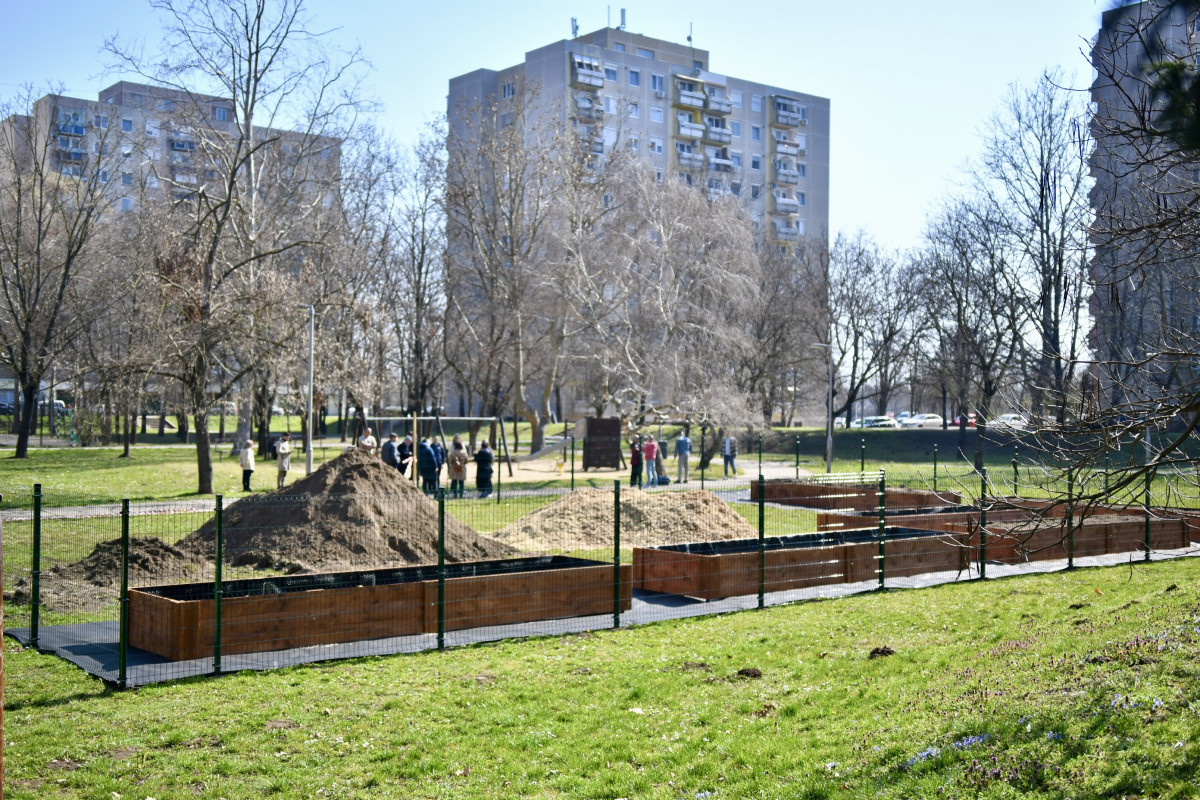
The details were shared during a press conference held on March 13, 2026, at the southern part of Tócóskert Square by Deputy Mayor Diána Széles and municipal representative András Varga.
As Deputy Mayor Széles explained, over recent years, community gardens have played an important role in fostering community spirit in residential areas. The first such garden was created in Vénkert and proved to be highly successful. Encouraged by this success and the demands and initiatives of local residents, the municipality began establishing additional gardens in other parts of the city, including Újkert and Tócóskert. In Debrecen’s 2026 budget, taking residents’ needs into account, two more gardens are planned: a second garden in the southern part of Tócóskert and one at the Ispotály-Erzsébet Street housing block near the playground. According to the deputy mayor, these gardens are not only meant to allow residents to experience the joys of small-scale gardening—planting seedlings and growing their own peppers and tomatoes—but also to encourage Debrecen residents to live not just alongside each other, but for each other, creating genuine communities in these shared spaces. Caring for one another strengthens communities, and strong communities strengthen the city. Széles Diána emphasized that Debrecen is a close-knit, strong community where people look out for each other. The creation of community gardens is a prime example of how urban development can be carried out in the interests of residents.
Mária Nagy-Bujdosó, the leader of the first Tócóskert Community Garden established in 2022, expressed her delight that their garden has served as such a positive example that a second facility can now be created in this neighborhood. She mentioned that they are entering their fourth season this year, and although the first season started in autumn rather than spring, the enthusiasm and momentum have remained unchanged, and the community is strong. She promised to support newcomers at the new Tócóskert site, emphasizing that all are citizens of “Tóci”—a city within a city—with a strong local identity. Nagy-Bujdosó also highlighted that community gardens are not just about producing healthy food, but about building communities, forming friendships, and organizing activities for families with children. Local schools and kindergartens are welcome to bring children to the gardens, where they can learn about nature, sustainable farming practices such as chemical-free cultivation, and the effects of climate change on plant growth, passing that knowledge on to others.
Municipal representative András Varga expressed his pleasure that the community garden has become so popular in Tócóskert that a second one can now be established. The new garden will feature 14 raised beds, accommodating 28 gardeners—just like the first Tócóskert Community Garden. It will include herb boxes, compost bins, and water access for irrigation. Varga highlighted that residents have a strong “Tócóskert identity” in addition to their Debrecen identity, and even if they move away, they will always carry a connection to the neighborhood. He emphasized that the existing and upcoming community gardens provide children with knowledge that cannot be learned from textbooks or online. Varga also expressed gratitude to the municipal staff responsible for green spaces and to the members of the first Tócóskert Community Garden for creating a model community that can guide new gardeners.
During the press conference, it was also noted that residents can continuously inquire about and apply for plots in the community gardens. Current information is available here: https://www.debrecen.hu/hu/debreceni/kozossegi-kertek/. Currently, waiting lists are common; for example, there are 16 people on the waiting list for the first Tócóskert Community Garden. Vacant plots are assigned from the waiting list in order of application. The annual participation fee is 4,000 HUF, which covers items such as tools, equipment replacement, and plant care, though gardeners typically contribute additional resources and labor to maintain the garden for the whole community. Membership is renewable annually if desired and supported by the community. Gardens primarily grow vegetables, but with the consent of the local community and municipal green space experts, fruit or ornamental trees and shrubs can also be planted, and trees may be added alongside the garden.
The second community garden under construction in Tócóskert is being developed by the municipality with a budget of 15 million HUF. Upon completion, expected in early April, work will begin on the community garden at the Ispotály-Erzsébet Street housing block.
(debrecen.hu)
Photo: debrecen.hu