






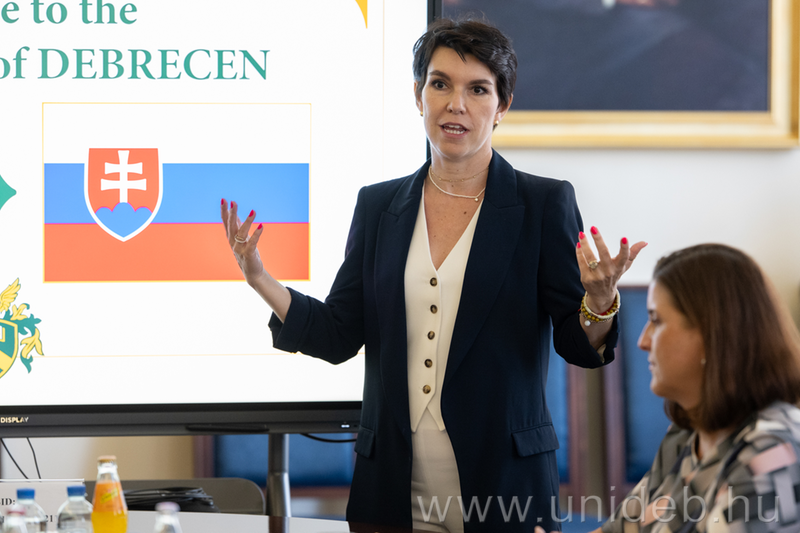
The cooperation between the University of Debrecen and the Slovak University of Agriculture in Nitra (SUA) is expanding into new academic fields. Following their collaboration in agricultural and food sciences, the two institutions will now strengthen their ties in engineering and economic sciences as well. The agreement, which includes lecturer and student exchanges, joint conferences, and research projects, was signed on July 9.
The partnership between the two universities dates back several decades and was originally established by the University of Debrecen’s Faculty of Agriculture, Food Science and Environmental Management (MÉK) and its predecessors.
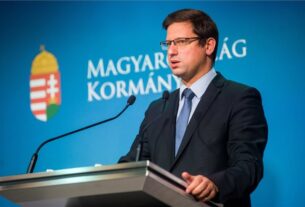
The delegation from the Slovak University of Agriculture in Nitra was welcomed in the Rector’s Council Room by Vice-Rector General Dénes Páll. He expressed his satisfaction that the partnership will now extend to the fields of economics and engineering as well.
“We were pleased to support Dean László Stündl’s initiative to take the active relationship between the two institutions to a higher level. The cooperation now involves three faculties of the University of Debrecen. This agreement will further strengthen our ties and contribute to the internationalisation of the University of Debrecen,” the vice-rector told hirek.unideb.hu.
The joint work between the two universities began around 50 years ago in the field of crop production and later expanded to rural development. As part of the cooperation, the institutions organised mutual visits, participated in joint conferences, and later became involved in international research projects together. Stündl László, Dean of MÉK, noted that the Slovak university’s similar institute served as a model for the creation of the Faculty’s Food Innovation Centre.
“Strengthening our relationship with the agricultural university in Nitra is important because people living in the Carpathian Basin face similar challenges. Late frosts and droughts affect the region in the same way, while the spread of pathogens and pests knows no borders. At the same time, we must continue producing high-quality food. This requires precision agriculture and a comprehensive scientific approach to establishing its technical and economic foundations,” said the dean.
He added that another important goal is to revive the Visegrad university cooperation network involving higher education institutions from several countries.
The new agreement will build on existing practices, including joint institutional visits, lecturer and student exchanges, and conference participation, while also creating opportunities for joint research projects and international initiatives in engineering and economic sciences.
At the event, which also included a press conference, Orsolya Jánosy, head of the University of Debrecen’s Centre for International Relations, presented the institution’s international strategy and partnership network. Géza Husi, Dean of the Faculty of Engineering, and László Erdey, Vice-Dean for International Affairs of the Faculty of Economics and Business, introduced their faculties’ educational programmes.
Géza Husi highlighted that, as a traditional engineering education centre, the Faculty of Engineering seeks cooperation with companies and institutions worldwide to provide practice-oriented training. Its research activities focus primarily on automation and robotics.
Speaking about the Faculty of Economics and Business, Vice-Dean László Erdey explained that the faculty maintains strong ties with MÉK, while its research also extends to health industry and sports science.
The Slovak University of Agriculture was founded in 1952 and is Slovakia’s only higher education institution specialising in this field. It operates six faculties offering bachelor’s, master’s and doctoral programmes in areas including agrobiology, animal and plant production, food science, biotechnology, regional development, horticulture, landscape architecture, economics and engineering. The university has around 4,500 students.
Lucia Palsová, Vice-Rector of the Slovak University of Agriculture, said that signing the cooperation agreement with the University of Debrecen is not merely a formality but a milestone for the institution.
“It represents a commitment to future joint opportunities. The agreement opens a new chapter in the lives of both universities. I firmly believe that agricultural science, environmental protection, economics and management can no longer be treated as separate fields, which is why partnerships are especially important,” she said.
The heads of the four faculties involved in the cooperation also visited Debrecen. Norbert Lukács, Dean of the Faculty of Biotechnology and Food Sciences at SUA, said that the two universities have significant opportunities ahead of them in international projects.
“Nitra and Debrecen are not far from each other. Within the European Union, climate change, food security and biotechnological innovations are receiving increasing attention. Our university has strong research groups working in these areas, offering excellent opportunities for joint projects,” he said.
Following discussions on the details of the agreement, the Nitra delegation visited the three faculties of the University of Debrecen involved in the cooperation.
(unideb.hu)