






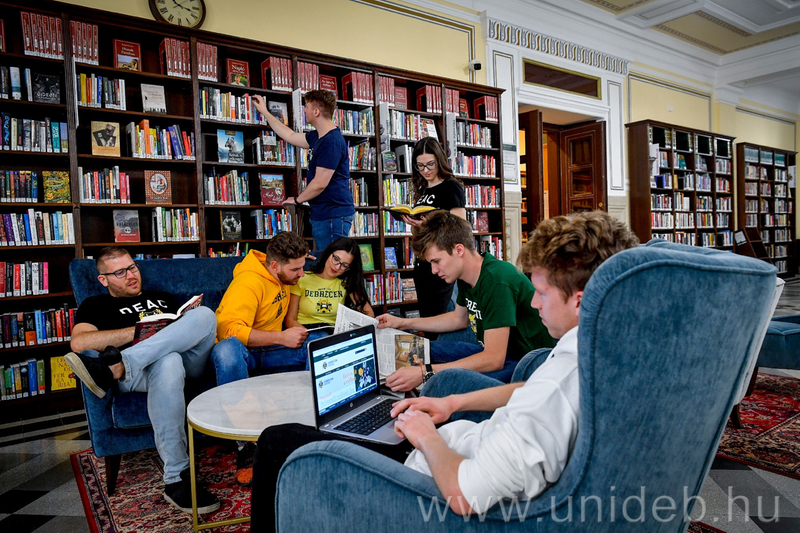
The University and National Library of the University of Debrecen (DEENK) has reached its 25th anniversary, having become one of the leading knowledge centers in the region and the country over the past quarter-century. To mark the occasion, DEENK is celebrating with a year-long series of events aimed at expanding knowledge and fostering collaborative thinking.
The library’s history dates back to 1916, and over the decades it has undergone continuous development, expansion, and transformation. In the second half of the 20th century, several independent faculty and university libraries operated in Debrecen. These merged in 2001, creating the DEENK known today, which continues to play a central role in supporting research, education, and university community life. Currently, DEENK serves readers through a total of nine libraries across four cities: Debrecen, Szolnok, Nyíregyháza, and Hajdúböszörmény.
Gyöngyi Karácsony, Director General, spoke about DEENK’s mission and its role within the university, noting that a comprehensive institutional strategy has been developed, emphasizing transparency, accessibility, and collaborative thinking.
“Following the university integration, we aimed to strengthen internal collaboration within DEENK, which led to several organizational changes. The Kassai Street Library and the Library of Life and Natural Sciences have opened, the latter celebrating its 20th anniversary this year. University leadership supported the presence of DEENK services on every campus, ensuring that all faculty and students can access the library under the same conditions and quality standards. Today, a conscious value system and organizational culture guide DEENK’s strategy and mission; we strive to keep pace with change, with proactivity as our guiding principle, living in harmony with our environment,” said the Director General.
She emphasized that the library’s importance in advancing research and education is unquestionable. DEENK impacts scientific work and seeks solutions to modern challenges affecting the effectiveness of teaching. Its cultural preservation and outreach efforts are made visible to the widest possible audience through effective communication activities.
“A complex service structure has been developed, and our celebratory programs also reflect our goal of understanding how our partners relate to the library, seeking opportunities to move forward through collaborative thinking. In research, we have developed a model covering the four phases of the research lifecycle—planning, conducting research, publishing, and publication management—helping researchers navigate the challenges of the AI era. DEENK has been fully and transparently integrated into university processes. For students, our goal is to develop critical thinking (information retrieval and management, citation management, AI tool usage) as well as soft skills (self-awareness, collaboration, stress management, communication, and presentation skills). For faculty, we aim to strengthen facilitation and creative visualization skills applicable in teaching,” Karácsony added.
Throughout the anniversary year, a variety of programs will reflect DEENK’s past, present, and future. Creative and community initiatives, playful experiences, and both online and in-person encounters will offer visitors opportunities to explore the library’s multifaceted world from new perspectives.
Special programs include the DEENK25 podcast series, which highlights personal memories and current topics, presenting the library’s diverse, human-centered character. Creative individuals are invited to participate in a poetry contest inspired by the library and reading. Plans also include a thematic escape room, emphasizing playfulness and creative thinking. In 2026, an alumni reunion will welcome retired DEENK professionals and former staff still connected to the institution. As part of the series, visitors will also explore the library’s spaces through an online self-guided tour. Several professional forums will foster dialogue on DEENK’s work, role, and future within the university ecosystem.
(unideb.hu)